A fitted sheet can have the right bed-size name and still behave like it is trying to leave. Before buying a deeper one, collect three measurements and read the exact fit claim. “Queen” is a useful label. It is not the whole specification.
This guide helps you compare an adult bed's dimensions with a fitted-sheet listing. It includes a copyable fit card and a worked example. It does not rank fabrics, promise better sleep or assume that a larger pocket always solves a loose corner.
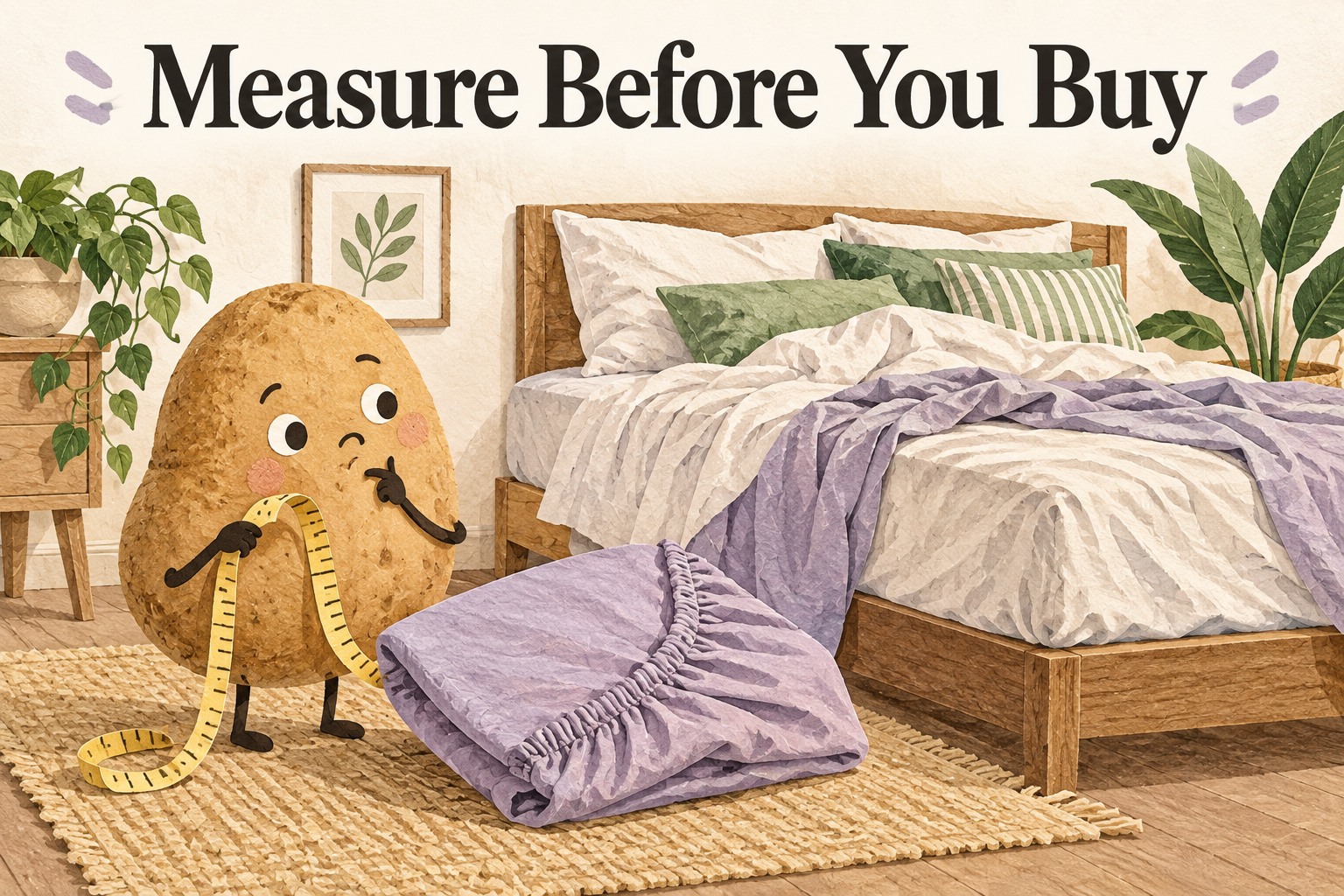
The quick check: footprint, height, wording
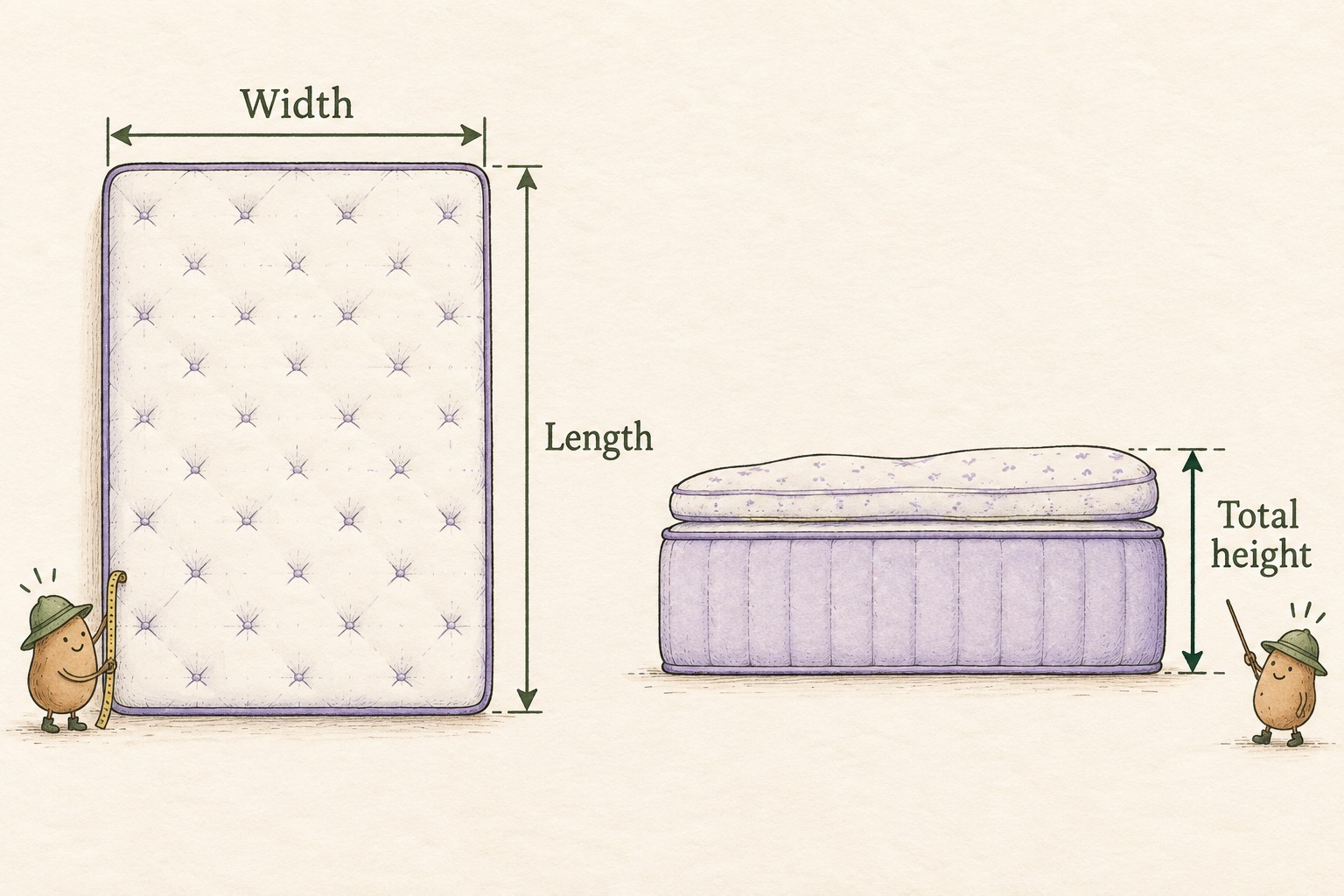
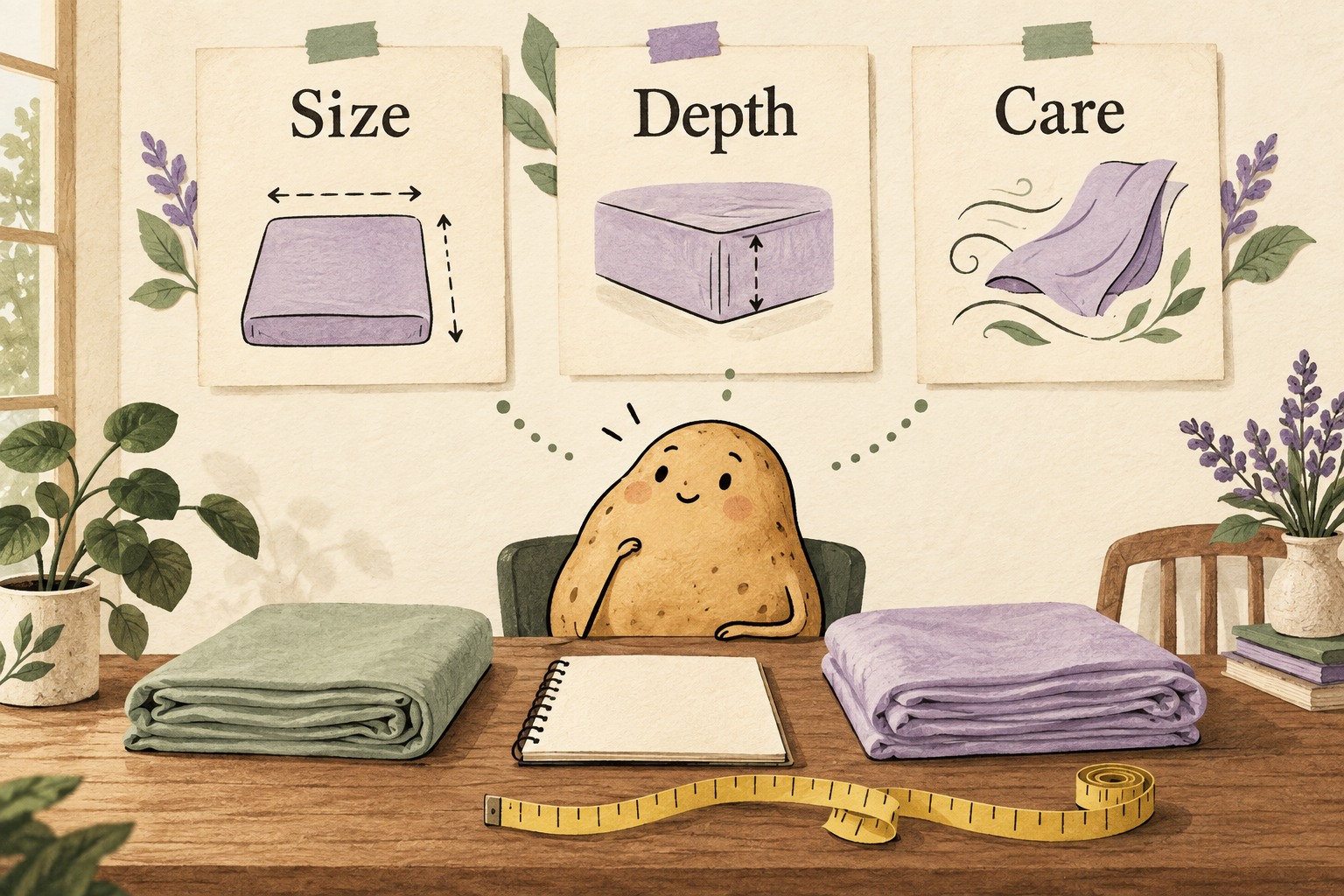
- Measure the mattress width and length.
- Measure the total height the sheet must cover, including the topper or pad that normally sits underneath it.
- Find the candidate sheet's exact dimensions and stated mattress-height compatibility.
- Check the care instructions and what is actually included in the pack.
- Keep the measurements and product details together so the next replacement is easier.
Use one unit throughout your note. If you need to convert, one inch is exactly 2.54 cm. Keep the original listing units alongside any conversion, especially when your setup is close to a stated limit.
1. Measure the bed you actually make
Remove the duvet, pillows and loose bedding. Leave in place the topper or pad that will normally sit under the fitted sheet. Measure straight across the mattress for width, then from head to foot for length. Measure the vertical height from the mattress's bottom edge to the top of the complete stack. Do not include the bed frame or foundation.
Keep the tape straight rather than wrapping it around a rounded corner. Do not compress a soft topper to make the number smaller. If the surface is uneven, check more than one place and record the largest relevant height plus a note about the variation.
The Big Bed Company's own measuring guidance includes the topper or pad in the height measurement. Its made-to-order sheets use the company's own added-depth guidance. That allowance is not a universal formula for every brand.
For a split bed, record each mattress separately if each takes its own fitted sheet. For an adjustable bed, use the sheet maker's guidance for that setup instead of assuming a static mattress measurement settles the question. There is no need to lift a heavy mattress to read a label you cannot safely reach; use accessible product records or ask for help.
2. Separate pocket depth from a stated fit limit
A listing may describe the sheet's pocket depth, the maximum mattress thickness it accommodates, or both. Copy the wording, not just the number. A fabric measurement and a compatibility statement answer different questions.
| Listing detail | What to record | What not to assume |
|---|---|---|
| Width and length | The exact dimensions and selected size variant | That the same size name guarantees the same dimensions everywhere |
| Pocket depth | The number, unit and maker's explanation | That every centimetre is usable mattress height |
| Fits mattresses up to / maximum thickness | The stated compatibility limit for that product | That you should add another generic allowance to it |
| Deep or extra deep | The actual measurement behind the label | That the label alone proves a fit |
For a concrete example, the IKEA Philippines DVALA listing for article 906.361.48 states 90 × 200 cm and a maximum mattress thickness of 26 cm. Those are details of that exact item, not every sheet sold under the DVALA name or every single bed.
If a listing gives a depth but never explains what mattress height it fits, leave the compatibility box unresolved. Ask the seller which measurement it means before ordering, especially near the limit. A confident guess is still a guess with postage attached.

3. Use this worked comparison
The following example is invented; it is not a recommendation for a product.
| Your recorded setup | Candidate listing | Decision |
|---|---|---|
| Width 150 cm; length 200 cm; total height 31 cm | 150 × 200 cm; fits mattresses up to 30 cm | The stated height limit does not cover the measured setup |
| The same setup | 150 × 200 cm; fits mattresses up to 35 cm | Passes the stated dimensional screen; still check the product guidance and care requirements |
| The same setup | “King, extra deep”; no dimensions or fit limit | Insufficient information; clarify before buying |
Passing this screen is not a guarantee of fit after use. Elastic construction, the particular mattress shape and the maker's instructions still matter. Equally, a sheet that is much deeper than needed may leave unwanted loose fabric. Choose a supported fit, not the largest number on the shelf.
4. Check care and pack contents before paying
Read the instructions for the exact fabric and product. Do not borrow washing settings from another sheet because it has the same color or bed-size name. The Company Store's Leander fitted-sheet listing, for example, gives its own cold gentle wash and low tumble-dry instructions. These are product-specific instructions, not a universal bedding routine.
- Can your usual laundry routine follow the care label?
- Is the price for one fitted sheet, a pair, or a set with other pieces?
- Are the selected dimensions and depth variant still correct in the basket?
- What does the seller say about checking fit, washing and returns for this item?
- Have you saved the product code and listing so the fit claim is traceable?
Check the seller's stated conditions before unpacking or laundering; do not assume that a washed or used sheet can be returned. This is a shopping check, not advice about statutory rights. If an existing sheet still fits, a new matching set may not be necessary.
5. Diagnose the old sheet before replacing it
If a corner keeps lifting, start with the simple checks. Is the sheet rotated correctly? Did a new topper increase the stack height? Does the product label match this bed? Is the elastic visibly worn, or has the item changed shape? Record what you can observe rather than declaring that every loose corner means the pocket is too shallow.
Compare the current setup with the original product's stated fit and care instructions. If a sheet used to fit but no longer does, identify what changed before ordering an identical replacement. Keep an uncertain item separate from the ready-to-use linen so it does not return to the bed by accident.
Copy this bed fit card
- Bed or room: __________
- Measurement date and unit: __________
- Mattress width × length: __________
- Total height, including these layers: __________
- Split or adjustable setup details: __________
- Candidate brand, product code and selected variant: __________
- Exact fit wording and limit: __________
- Care requirements checked: __________
- Pack contents and seller conditions checked: __________
- Unresolved question before buying: __________
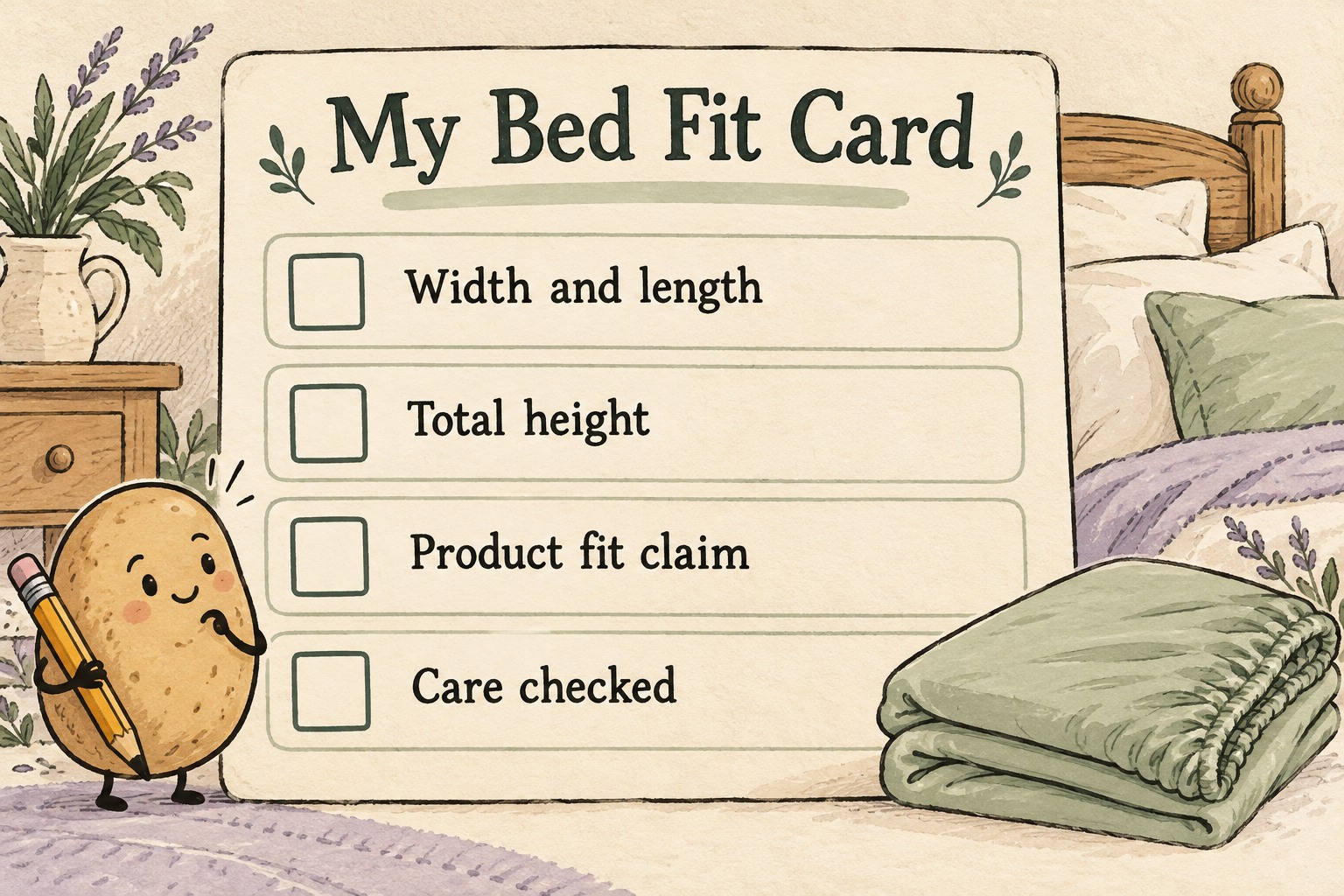
Keep the card with your household shopping note and update it when the mattress or topper changes. For the washing side of the job, use our care-label sorting checklist. The goal is a sheet that fits your actual bed and routine, with less corner wrestling and fewer speculative purchases.