A dishwasher is not a cupboard with a weather system. Getting the door shut proves that the dishes fit inside; it does not prove that water can reach them.
Use this clearance-first routine before starting a normal household load. It combines manufacturer guidance with an original load map you can adapt to your own machine. The appliance manual and the item's care instructions take priority over any generic rack diagram.
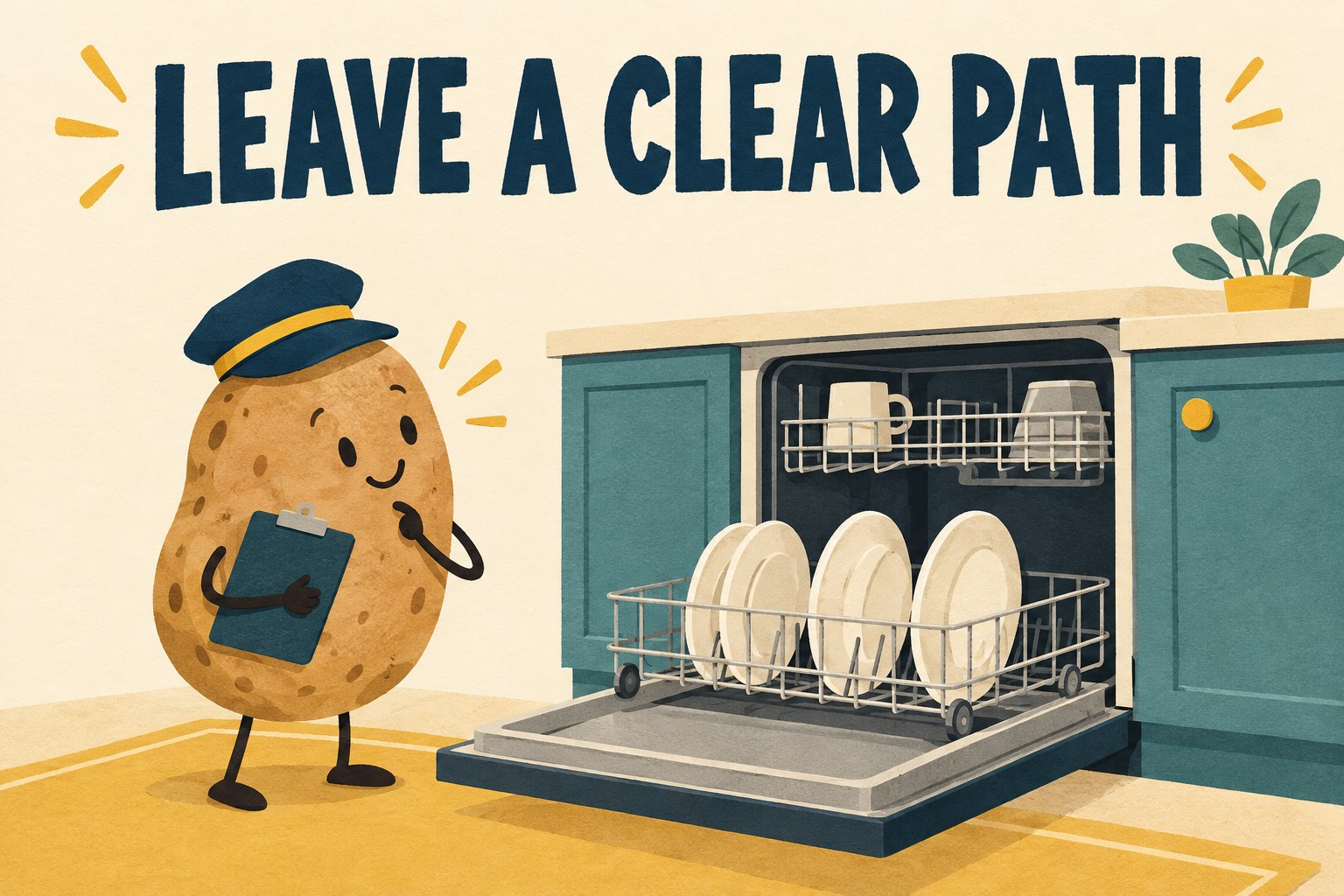
Start with two permissions: the item and the rack
Check whether the item is dishwasher-safe and whether its maker specifies a rack, cycle or temperature restriction. An item that fits is not automatically suitable. If its instructions are missing or unclear, keep it out of this load while you check. Do not use this guide to identify an unknown material.
Then find your dishwasher's exact model instructions. Whirlpool's loading guide explicitly notes that rack designs differ and directs owners to their own manual. A shallow third rack is not interchangeable with the cup rack below it.
Make a short household map rather than memorizing a stranger's perfect arrangement:
- Everyday plates: our approved rack and orientation __________
- Mugs and bowls: our approved position __________
- Dishwasher-safe plastics: item restrictions and secure location __________
- Long utensils: designated place __________
- Large tray: position that leaves all required clearances __________
- Items we hand-wash: __________
This map is a shared reminder, not a new appliance instruction. Add the manual link or model number so another person can verify a doubtful item.

Give each dirty surface a route to the wash
Remove loose food scraps before loading. For routine preparation, Whirlpool recommends scraping and spacing dishes with soiled surfaces toward the jets. Do not turn that into an absolute rule for every delayed load: Frigidaire's guide gives specific rinse advice for certain food residues left standing. Follow the preparation guidance for your machine and circumstances.
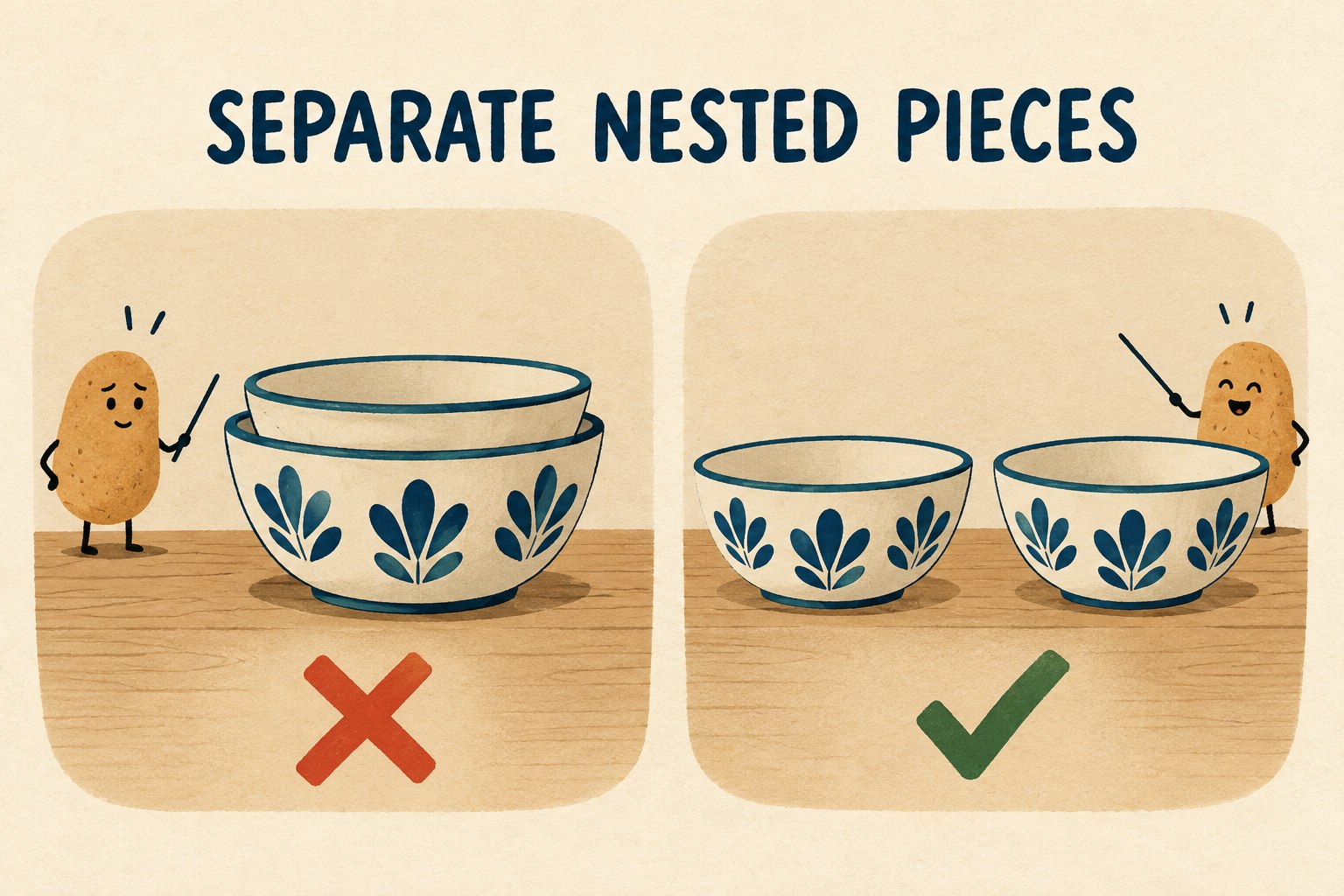
Arrange eligible items so they do not nest together. A bowl tightly inside another bowl creates a hidden surface. For cups and other hollow pieces, follow the rack instructions for an opening-down or angled position that allows drainage. Keep delicate pieces from touching and do not balance an unstable item on top of an otherwise good load.
For cutlery, use the provided separators or the model's loading pattern to prevent spoon-to-spoon nesting. Whirlpool's operating guide specifies sharp objects pointing downward in the basket; follow your model's sharp-item safety instructions. Do not leave a knife point sticking up merely to make a photograph look tidy.
Check the two easy-to-miss clearances
LG's loading guidance puts large sheets and pans at the sides or back where they will not interfere with the spray arms or detergent dispenser. The useful question is not simply “side or back?” It is “what does this object obstruct in this particular machine?”
- Spray-arm path: with the machine stopped and cool, use the manual's check to make sure loaded items do not obstruct rotation. Frigidaire's guide describes checking by turning the arm by hand. Do not force a part or reach into a running machine.
- Dispenser path: check that a large plate, board or tray is not in the way of the dispenser opening. Account for the racks being in their operating position, not only pulled out for loading.
Look below the rack as well as above it. A long handle can project into a moving part's path even when the top looks orderly. If you cannot achieve the required clearances, remove the awkward piece and wash it by an approved method or in a later suitable load. “One more thing” is optional; clearance is not.

An example: the baking tray that wins the space argument
Suppose an eligible tray fits across the front of the lower rack but stands in front of the detergent compartment. This is an invented example, not a test result.
| Observation | Useful change | Check again |
|---|---|---|
| Tray blocks the compartment | Try a manual-approved side or rear position | Dispenser path remains clear with racks in place |
| Tray now interferes with an arm | Remove it rather than force the arrangement | Remaining load has the required clearance |
| Two bowls hide each other's interiors | Separate and orient them according to the rack guide | Both are stable and exposed to the wash |
The aim is a repeatable arrangement for the dishes you own. Save a photo of a successful layout for the household, but label unusual exceptions. A photo cannot tell someone whether a newly purchased cup has different care instructions.
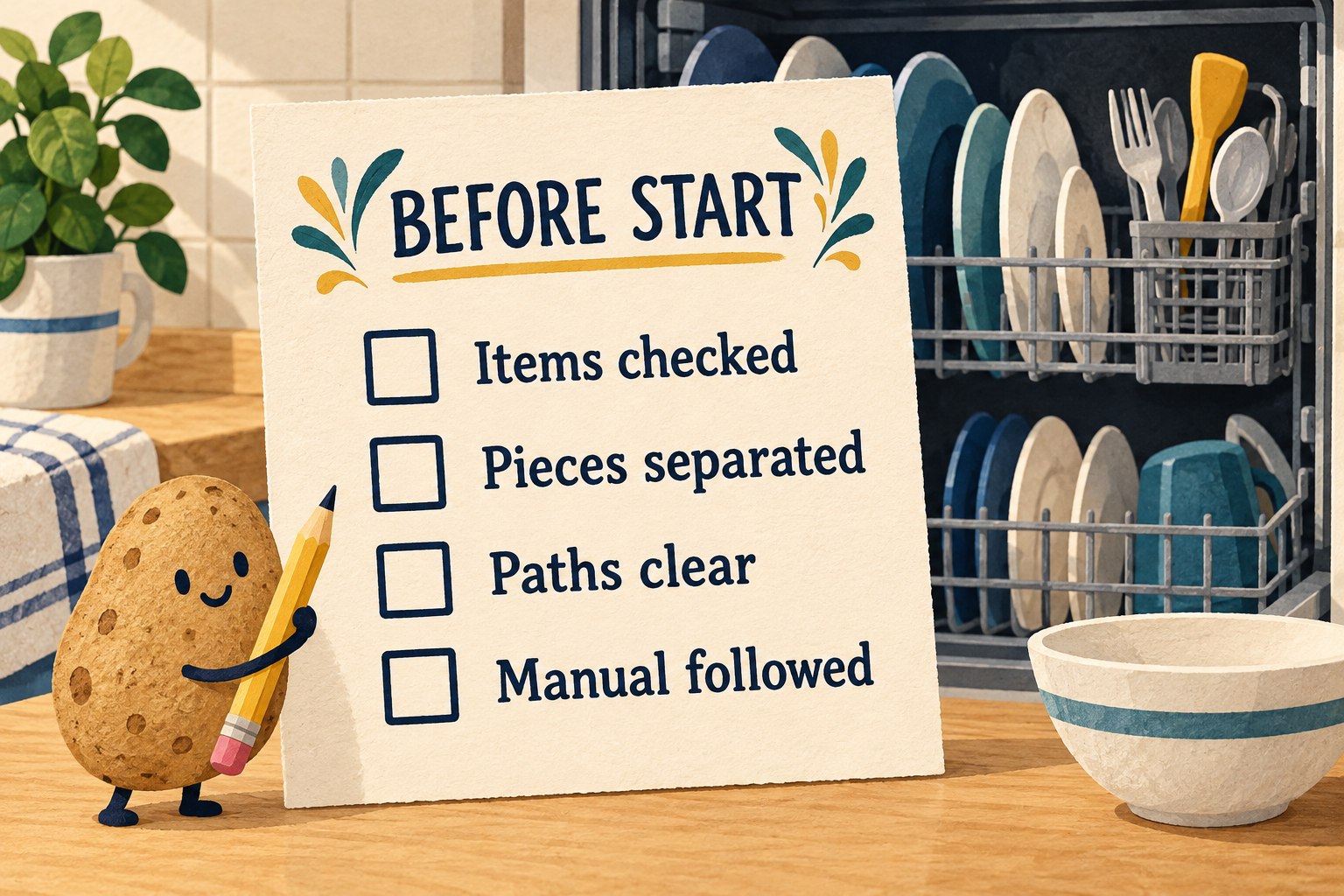
Copy this before-start and next-load card
- Model/manual: __________
- Uncertain or unsuitable items removed: __________
- Nested pieces separated; hollow items oriented as directed: __________
- Long pieces and sharp items safely placed: __________
- Spray-arm and dispenser clearance checked: __________
- Detergent and cycle chosen using the manual: __________
- After the cycle, problem item and position: __________
- One placement change to try next time: __________
If results remain poor after correcting the load, use the manufacturer's troubleshooting instructions rather than assuming arrangement is the only cause. This checklist does not diagnose a blocked filter, water-supply fault or dispenser problem, and it makes no promise that every mark will disappear.
Once clean items are ready to put away, the container-and-lid audit helps them return to usable pairs. The small victory here is simpler: everyone in the household can load the machine without having to solve the same kitchen puzzle again.