The suitcase has made it home. Its contents are considering a longer stay. Rather than trying to restore your whole house after a trip, give the bag one clear finish line: everything has a destination, the case is dry, and the next packing list contains one useful lesson.
This original unpacking checklist separates a quick arrival pass from a later luggage reset. It is an organizing method, not a timed challenge or a claim that every traveler can finish in fifteen minutes. Adjust the lifting and workspace to what is comfortable for you.
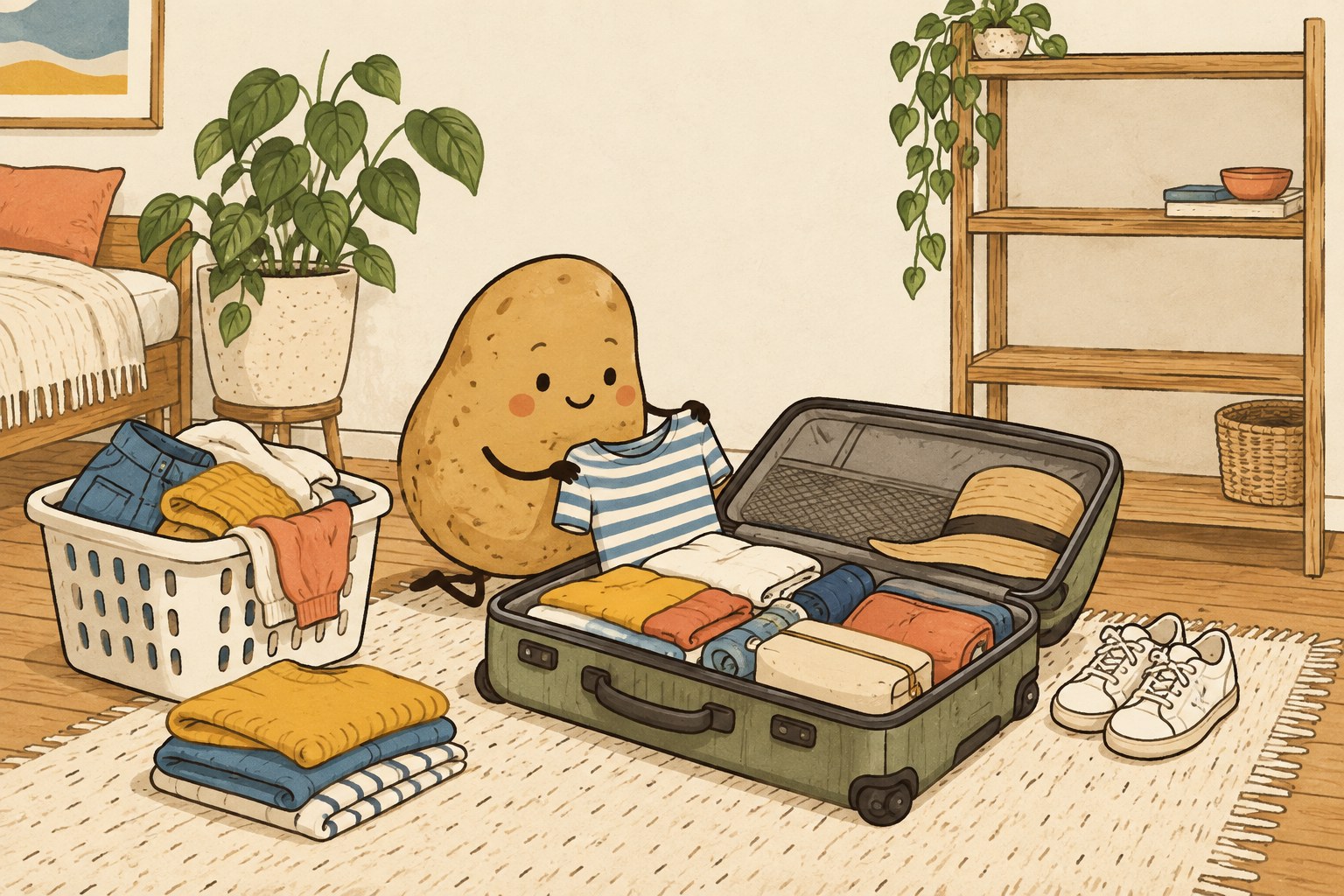
Start with a landing space, not a bigger pile
Choose a clear, stable spot where you can open the case without blocking a doorway. Keep it off a bed or food-preparation surface while you sort. Bring a laundry basket and a small tray for loose items. You do not need a new organizing product: existing containers are enough.
On the first pass, retrieve items you need for normal life: keys, glasses, documents, your everyday charger and tomorrow’s clothes. Return important documents to their usual secure place. Take out damp clothing and anything that has leaked so those items can be handled according to their care instructions. If you are too tired to finish, stop after this priority pass and choose a specific return time.
A useful stopping note: “Daily essentials are put away. The damp towel is out. The inside pockets and toiletry pouch still need checking. I will finish after breakfast.” This is more useful than a suitcase silently waiting beside the door.
Give each item one of three destinations
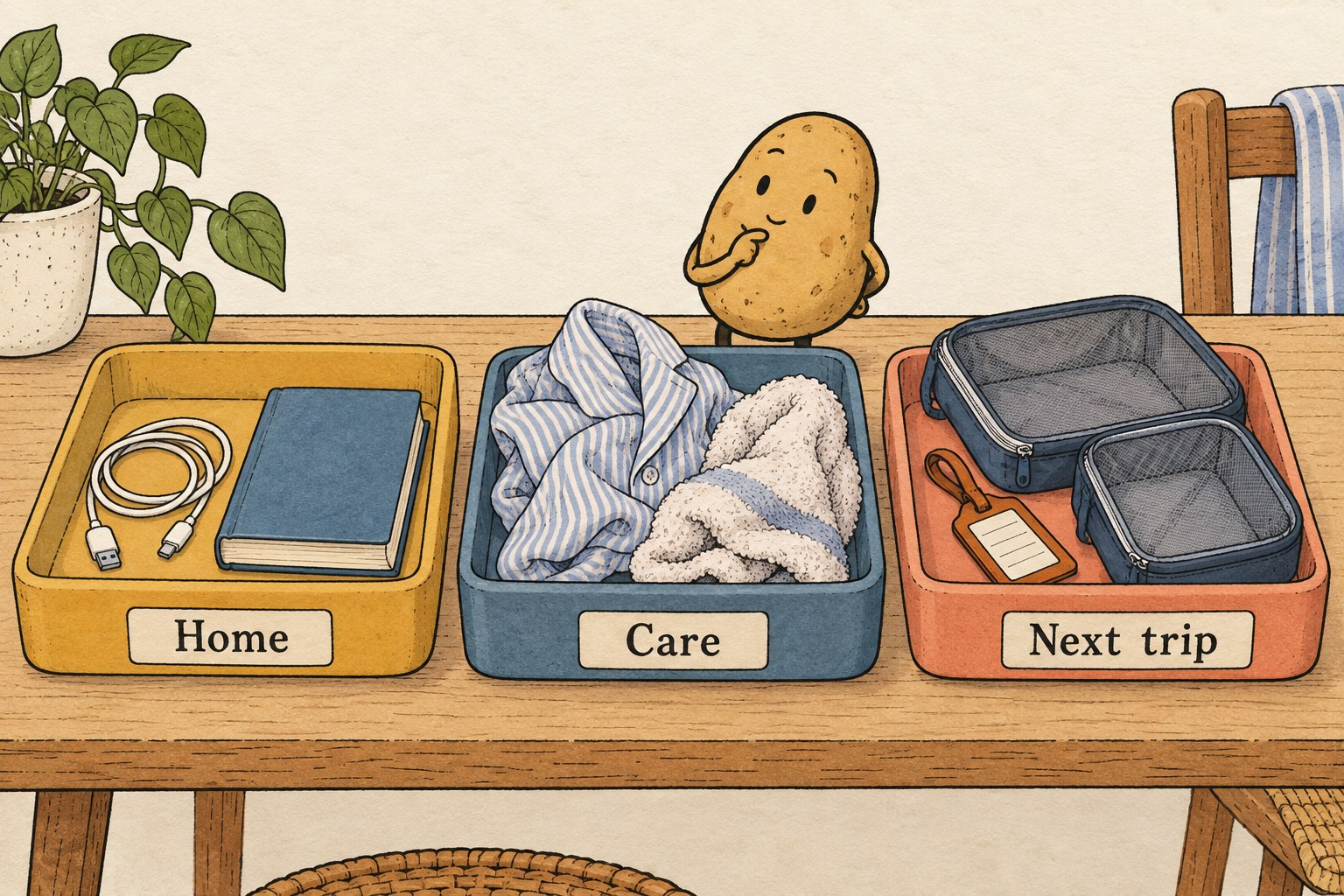
| Destination | What belongs here | What counts as finished |
|---|---|---|
| Home | Items used in everyday life, such as a book, cable or clean clothes | Returned to their usual location, rather than another temporary pile |
| Care | Laundry, damp items, an empty toiletry bottle, or equipment needing attention | Moved to the appropriate care process, or given a specific next action |
| Next trip | Travel-only organizers and accessories you genuinely expect to use again | Checked, clean and dry, with missing or damaged items recorded |
For clothes, distinguish unworn items that can go away from pieces that need washing or another care method. Do not make one enormous “travel wash” just because everything shared a suitcase. Our care-label wash-and-dry checklist helps separate compatible loads and drying routes.
For toiletries, check caps and containers before returning them to storage. Record what is actually empty or missing. Avoid immediately buying a complete replacement kit: something in your bathroom may already fill the gap. Keep products in appropriate, clearly identified containers and follow their storage instructions.
Do a pocket sweep before declaring the bag empty
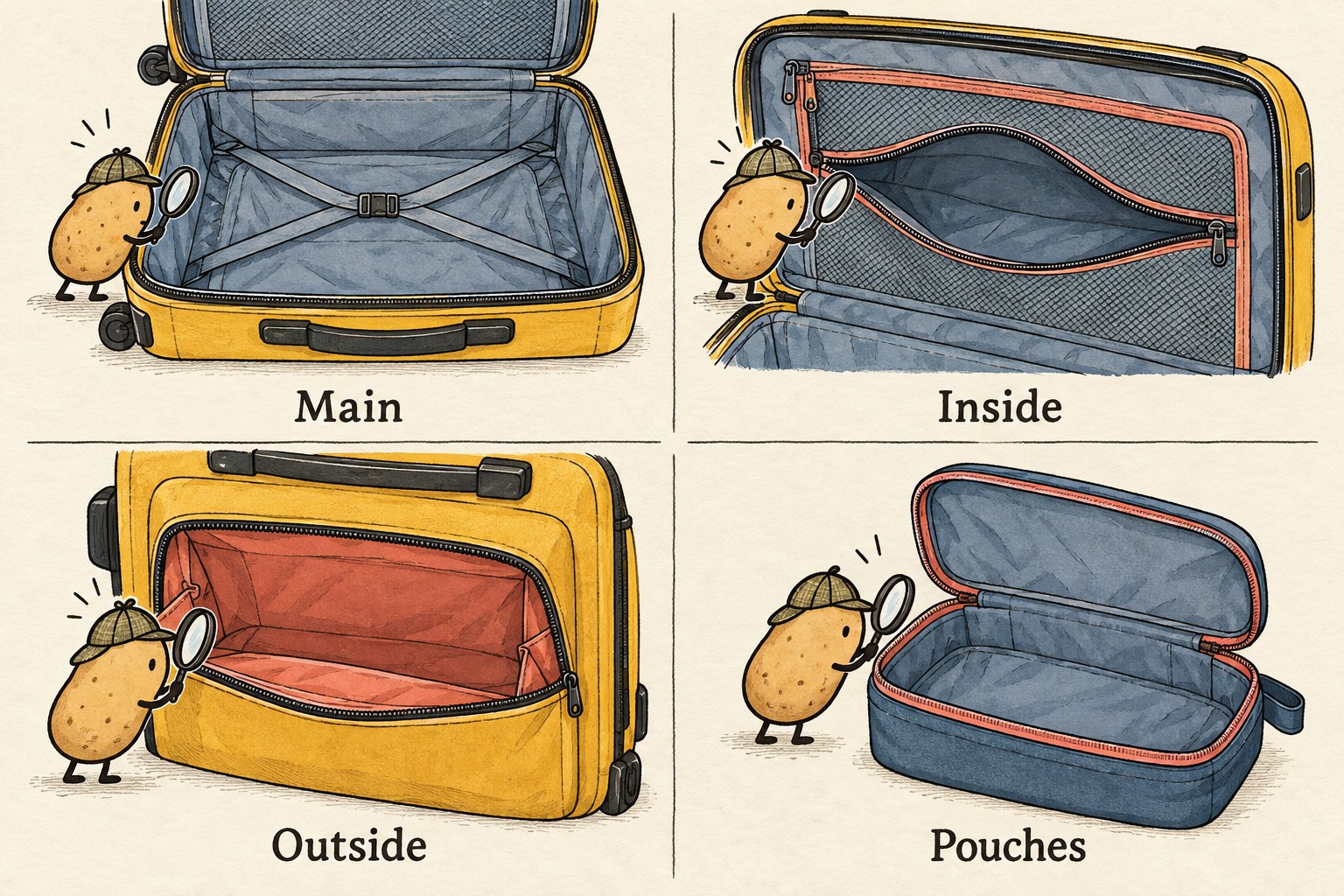
A case can look empty while a small adapter remains behind a lining pocket. Work through the same sequence each time:
- Open the main compartment and lift out packing cubes or dividers that are intended to be removable.
- Check every internal zip pocket and accessible corner. Do not pull apart a fixed lining.
- Check external pockets, bottle holders and any separate shoe section.
- Open each small pouch rather than assuming its contents are unchanged.
- Check the bag you carried on your shoulder as well as the suitcase.
Put papers that need action in one place with a note explaining the action. Return borrowed items to a named person or an agreed collection spot. Neither belongs in the “next trip” pile simply because it is small enough to disappear there.
Clean for your particular case, then wait for it to dry
Start with the luggage maker’s instructions for the specific material and model. For example, Samsonite’s care guide gives different guidance for hard-shell cases, fabric luggage and travel accessories. A method suitable for one material is not blanket permission to use it on leather, a coated fabric or a removable electronic component.
Remove loose debris and check for obvious damage while the bag is empty. If cleaning is needed, use only methods appropriate to the product; do not improvise a mixture of cleaning chemicals. A removable lining is not necessarily machine-washable, so check its instructions separately.
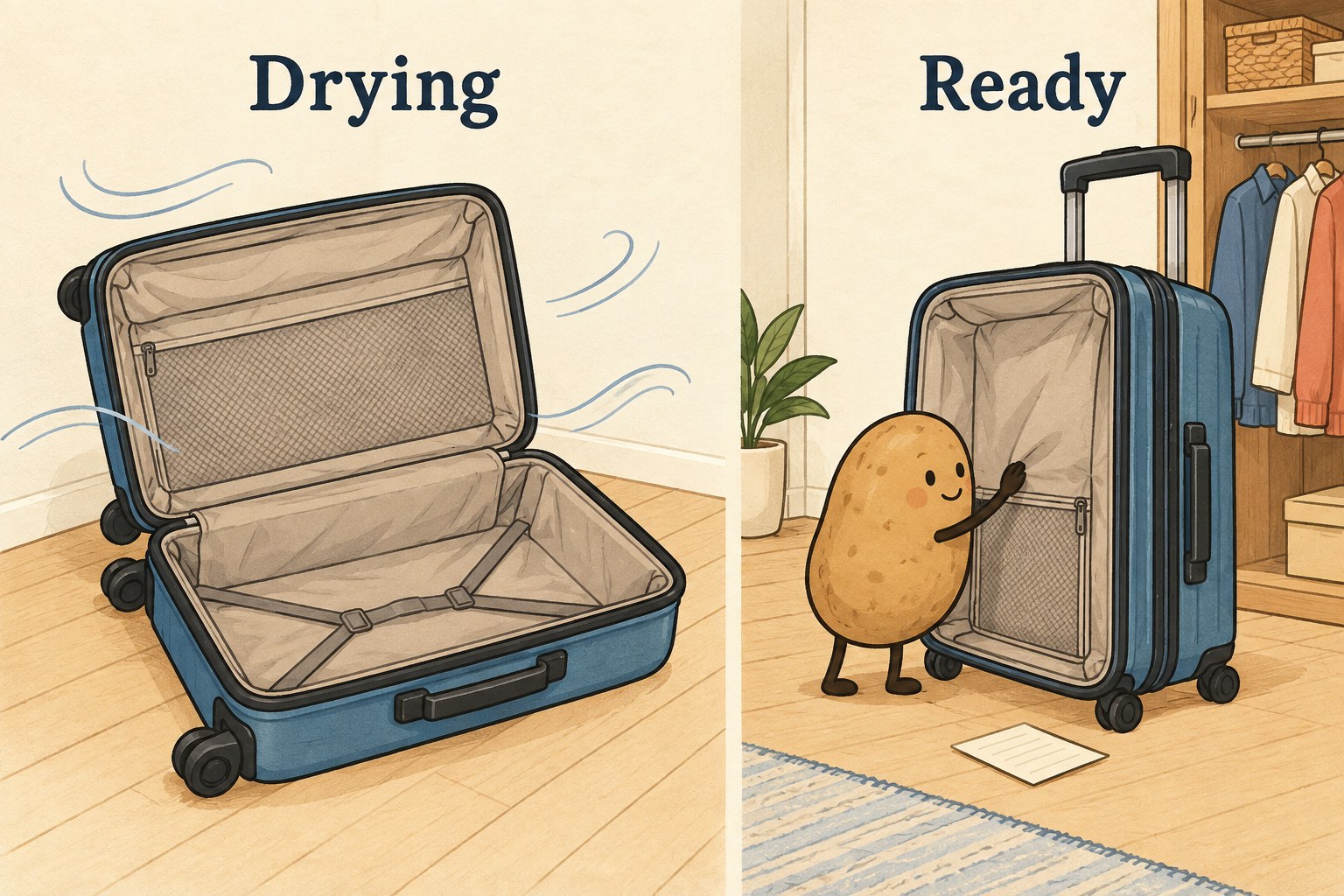
Samsonite Australia’s storage guidance says to let the case and lining dry completely before storage and to favor a cool, dry place. Follow your own maker’s guidance where it differs. There is no universal drying time: the material, how wet it became and the room conditions all matter.
Use two separate statuses in your note: unpacked and ready to store. If the lining is still damp, the first can be complete while the second remains open. Keep the case safely out of the walkway as it dries. Do not tuck a damp packing cube inside and call the job done.
While the case is empty, gently check that its zippers, handle and wheels operate normally. Record an issue before the next departure, and use the manufacturer’s service guidance rather than forcing a jammed part. The goal is to notice a problem, not to turn unpacking into a repair experiment.
Write one next-trip note instead of a whole travel diary
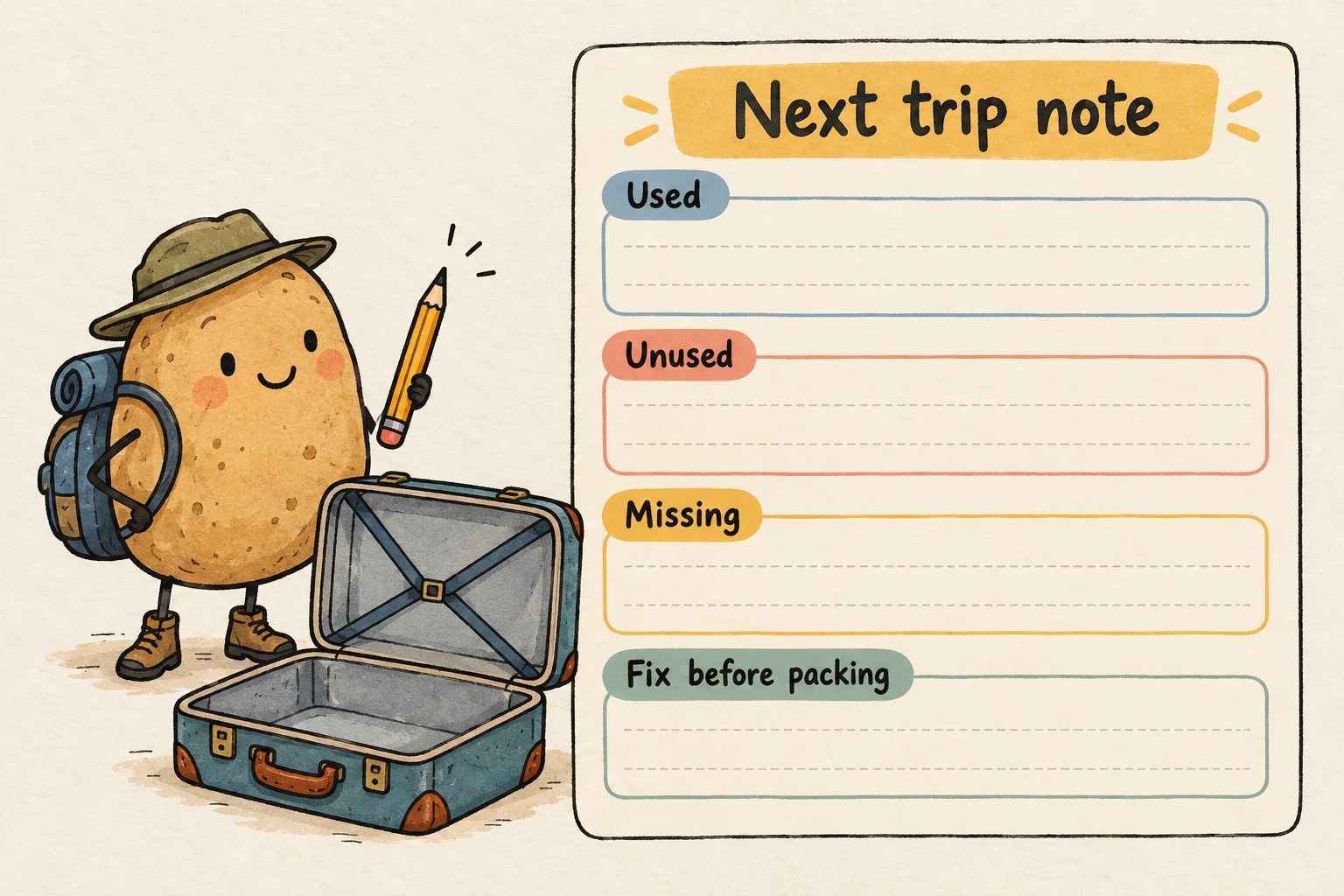
Copy this card into the place where you keep your packing list. Keep it short enough that you will actually read it next time.
- Used: What earned its space? ______
- Unused: What might I reconsider for a similar trip? ______
- Missing: What did I need but not have? ______
- Fix before packing: What needs repair, cleaning or replacement? ______
- Trip context: Length, weather and planned activities: ______
An unused item is a question, not an automatic deletion. A rain layer on a dry weekend may still be sensible on another itinerary. Compare like trips before cutting a useful backup. Likewise, something you borrowed once does not automatically deserve a purchase.
Invented example: After a three-night city trip, you note that one pair of shoes stayed in the case, the short charging cable was inconvenient, and a packing cube zipper caught. For the next similar trip, reconsider the spare shoes, use a longer cable you already own, and inspect the zipper. This is a packing adjustment, not a shopping list.
The close-the-case checklist
- Everyday essentials and important documents are back in their usual places.
- Clothes and other items needing care have a destination or a clear next step.
- Main, inside and outside pockets, plus separate pouches, have been checked.
- The case and any items stored inside it are clean as needed and fully dry.
- Problems with handles, wheels or zippers are recorded.
- The next-trip note is saved beside the packing list.
- The case has a suitable storage location and is no longer blocking the room.
If one item is unfinished, name it. “Waiting for the lining to dry” is a legitimate status. “Almost unpacked” is how a suitcase becomes a coffee table.
When the next departure comes around, use our three-day carry-on packing list as a starting point, then apply the short note you made this time. The most useful packing advice may already be sitting in your own bag.