The tallest cereal box is not automatically the best deal. Compare the price for the same amount, then ask whether the package fits the way you actually shop.
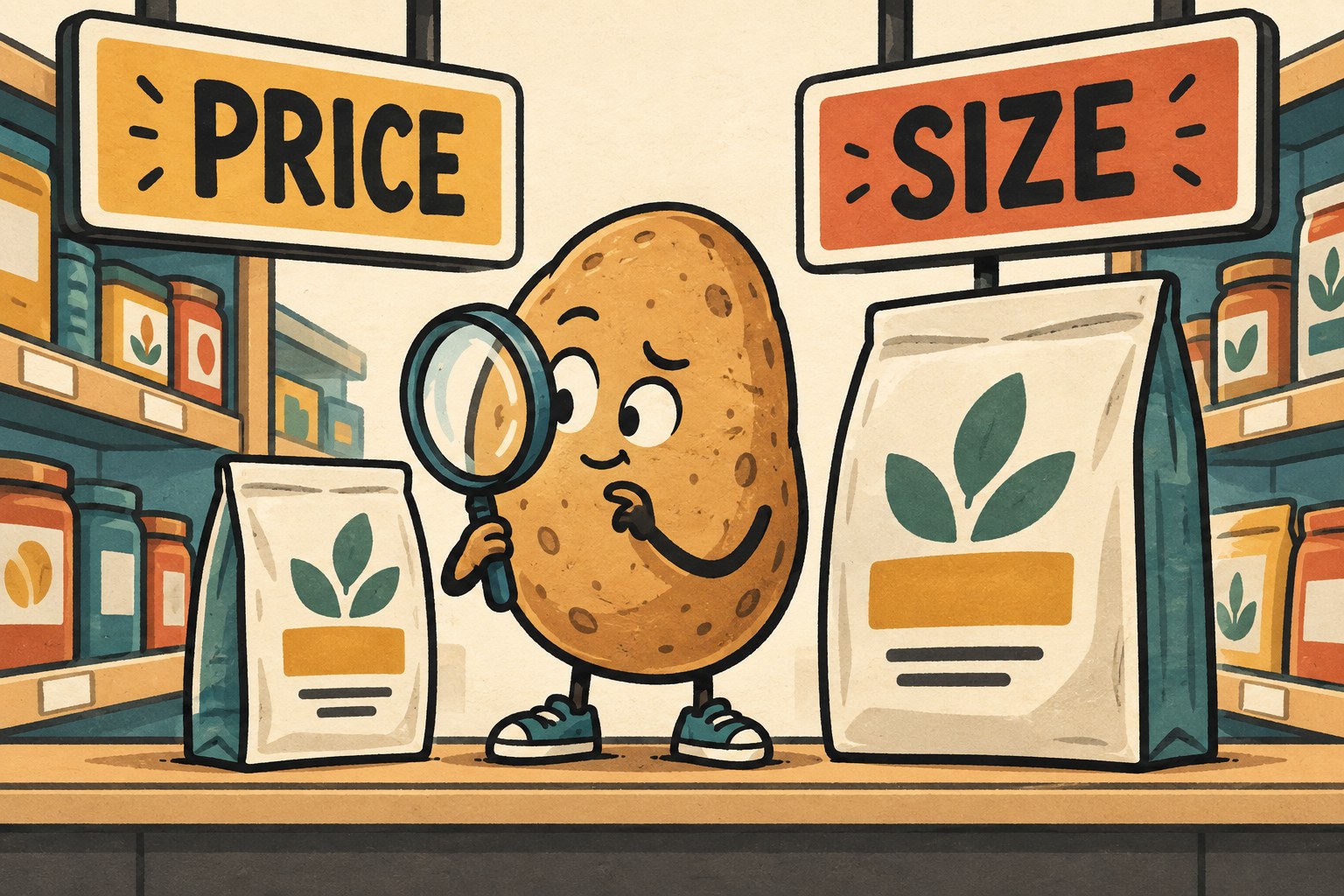
This guide gives you a small, repeatable price check for ordinary groceries and household supplies. The numbers below are fictional teaching examples, not current store offers. You need only the price you qualify for, the package quantity and a calculator.
Start with two products that do the same job
Choose alternatives you would genuinely buy. A bargain on something you dislike is an excellent way to acquire a cupboard ornament. Check the product type, quantity description and any meaningful differences before doing arithmetic.
The NIST Unit Pricing Guide recommends consistent units for comparable products and clearly distinguished selling and unit prices. For a shopper, the useful principle is simple: compare the same kind of quantity on both sides.
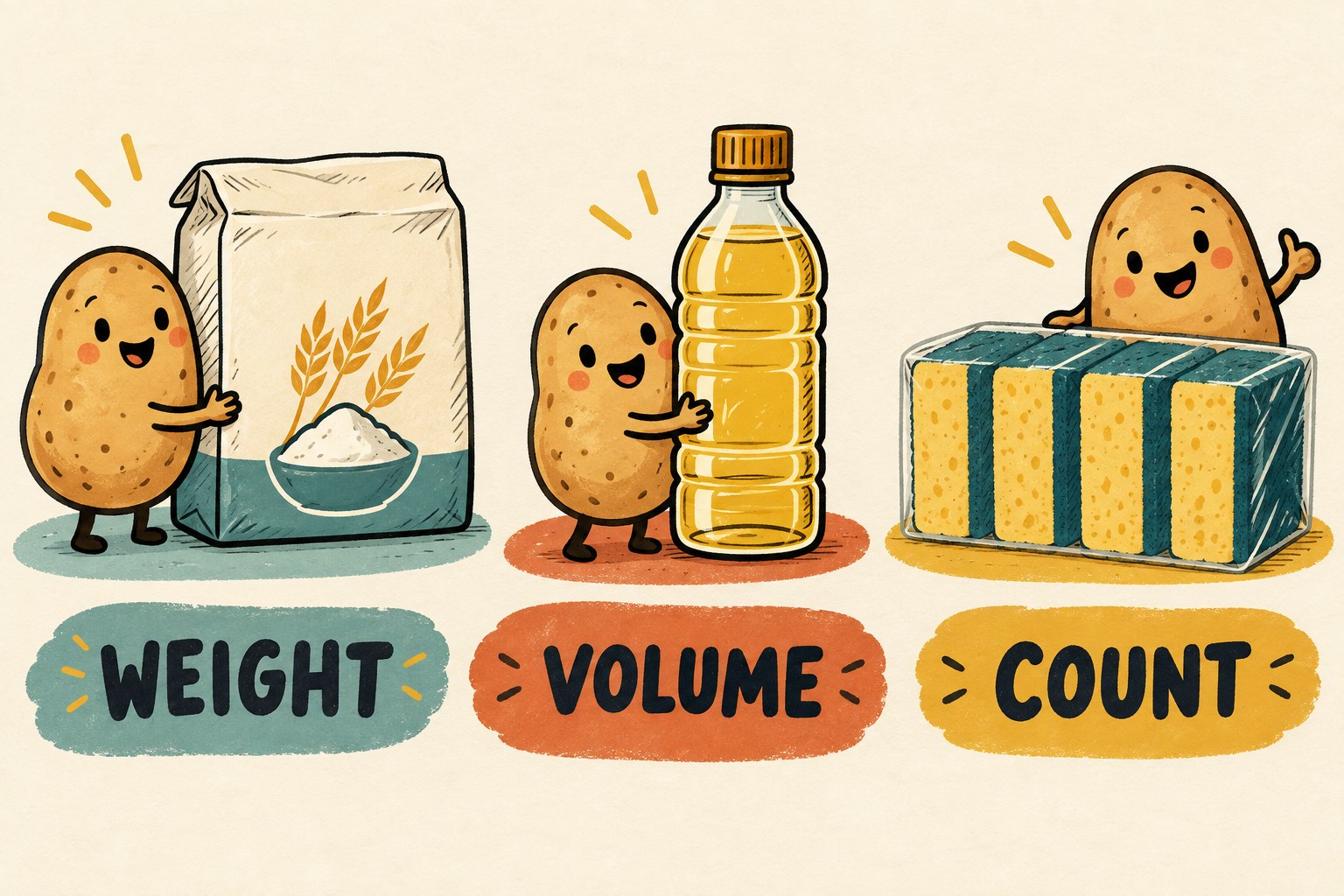
- Compare weight with weight, such as grams with grams.
- Compare volume with volume, such as milliliters with milliliters.
- Compare count only when the individual items are meaningfully comparable.
A roll is a count, but two rolls may contain different amounts of paper. A fluid ounce measures volume; an ounce on a weight label measures mass. Do not treat them as interchangeable. For canned foods, compare the same weight basis, such as drained weight with drained weight. If a package or shelf label is unclear, check the package details or ask the store instead of guessing.
Calculate a common unit price
Price per comparison unit = package price ÷ package quantity × comparison quantity.
For a price per 100 grams, divide by the number of grams and multiply by 100. For a price per item, divide by the total number of comparable items. Keep all quantities in the same unit before calculating; for example, 1 kilogram is 1,000 grams.
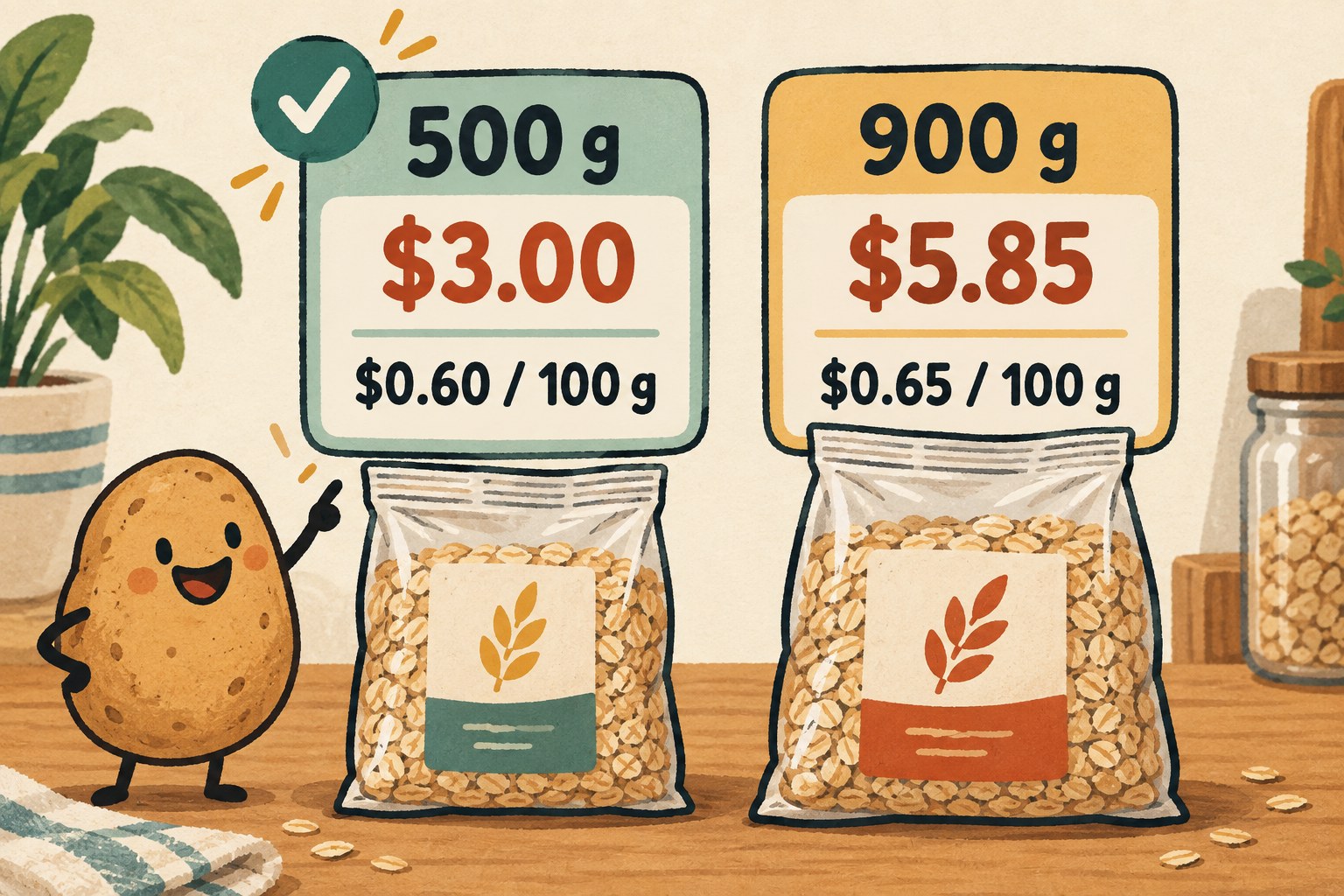
| Fictional option | Package price | Quantity | Price per 100 g |
|---|---|---|---|
| Small bag | $3.00 | 500 g | $3.00 ÷ 500 × 100 = $0.60 |
| Large bag | $5.85 | 900 g | $5.85 ÷ 900 × 100 = $0.65 |
In this example, the smaller bag costs less per 100 grams and less at checkout. That does not establish a general rule about package sizes. The UK's Competition and Markets Authority pricing analysis found examples where larger packs had higher unit prices. Its evidence supports checking the actual offer rather than assuming that bulk wins.
When results are very close, keep the unrounded calculator values until you have compared them. Round only for your note. Differences in displayed rounding should not become a fictional saving.
Use the price you can actually get
A shelf can show a regular price, a loyalty price and a coupon price at once. Before copying a number, read the conditions. NIST's guide recommends unit prices for regular and promotional offers, including club-card and digital-coupon prices; a promotional label still needs your eligibility check.
- Match the item. Confirm the exact product and size named on the offer.
- Check the requirement. Look for membership, a clipped coupon, minimum quantity, purchase limits and the offer's dates.
- Use the qualifying total. If the offer requires two packs, calculate with the combined price and combined quantity.
- Check the checkout result. If the discount did not apply, resolve it or compare again using the actual price before paying.
For example, two 400-gram packs for $4.80 contain 800 grams in total. Their price is $4.80 ÷ 800 × 100 = $0.60 per 100 grams. If a single pack is $2.70 and the two-pack offer requires buying two, do not enter $2.40 as the price of the one pack you intend to buy.
For online shopping, keep delivery charges, order minimums and other mandatory checkout costs visible in a separate order-total check. A cheaper item does not necessarily produce a cheaper delivered basket. Do not spread an order-wide fee across one item and present the result as the store's shelf unit price.
Give a low unit price three final checks
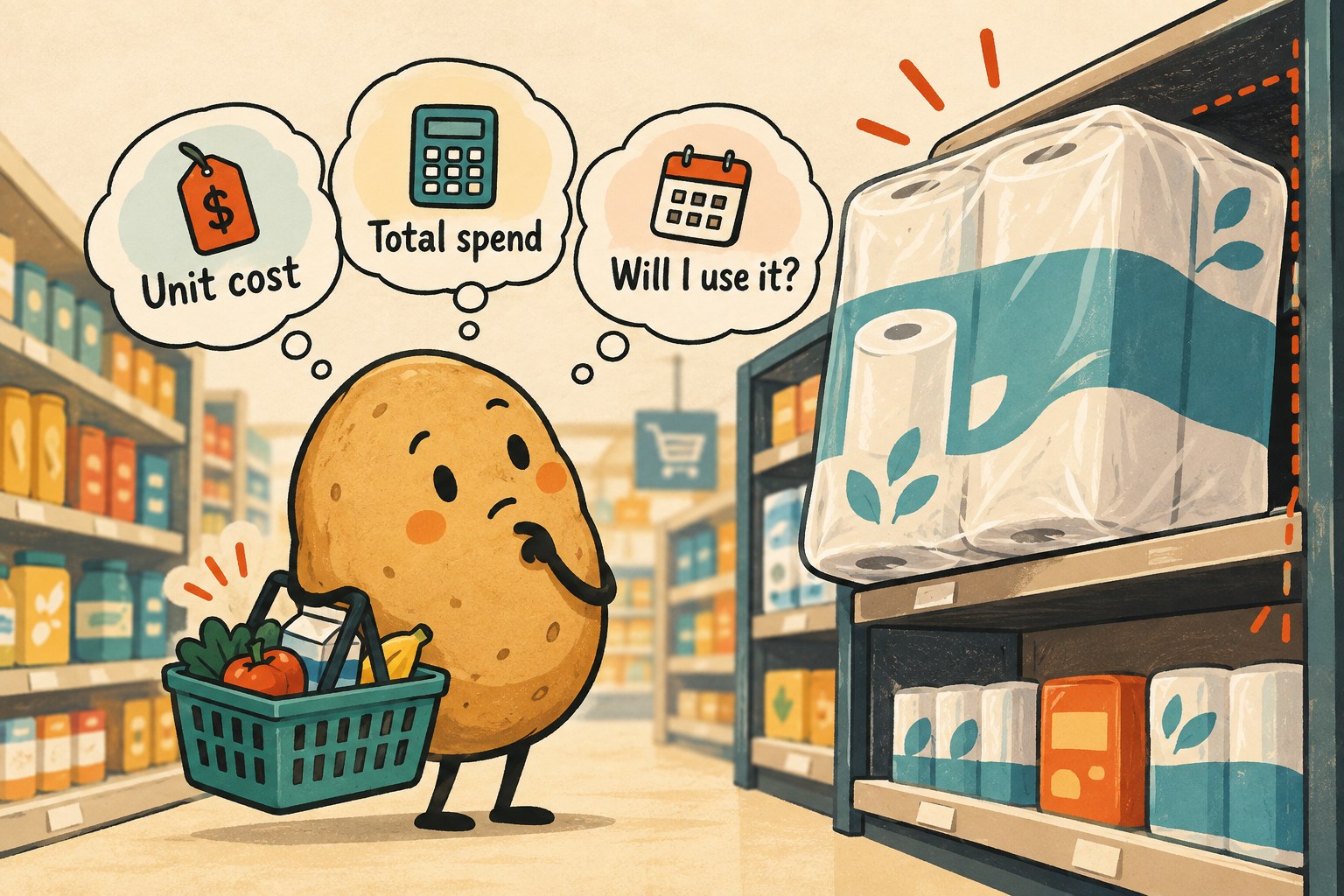
The calculation answers “Which costs less for this amount?” Your final decision also needs these questions:
- Total spend: Is the amount you would pay today acceptable for this purchase?
- Use: Do you expect to use this quantity, rather than buy extra solely to unlock the offer?
- Space and suitability: Can you store it as directed, and is this the product you wanted?
You do not need an invented spoilage percentage to say no to an oversized pack. If you cannot tell whether you will use it, record that uncertainty. The smaller purchase may fit your needs even when its unit price is higher.
Before adding quantities you already own, try the pantry inventory and gap-only grocery list. That article helps decide what is missing; this one helps compare the alternatives once an item belongs on the list.
Copy this price-check note
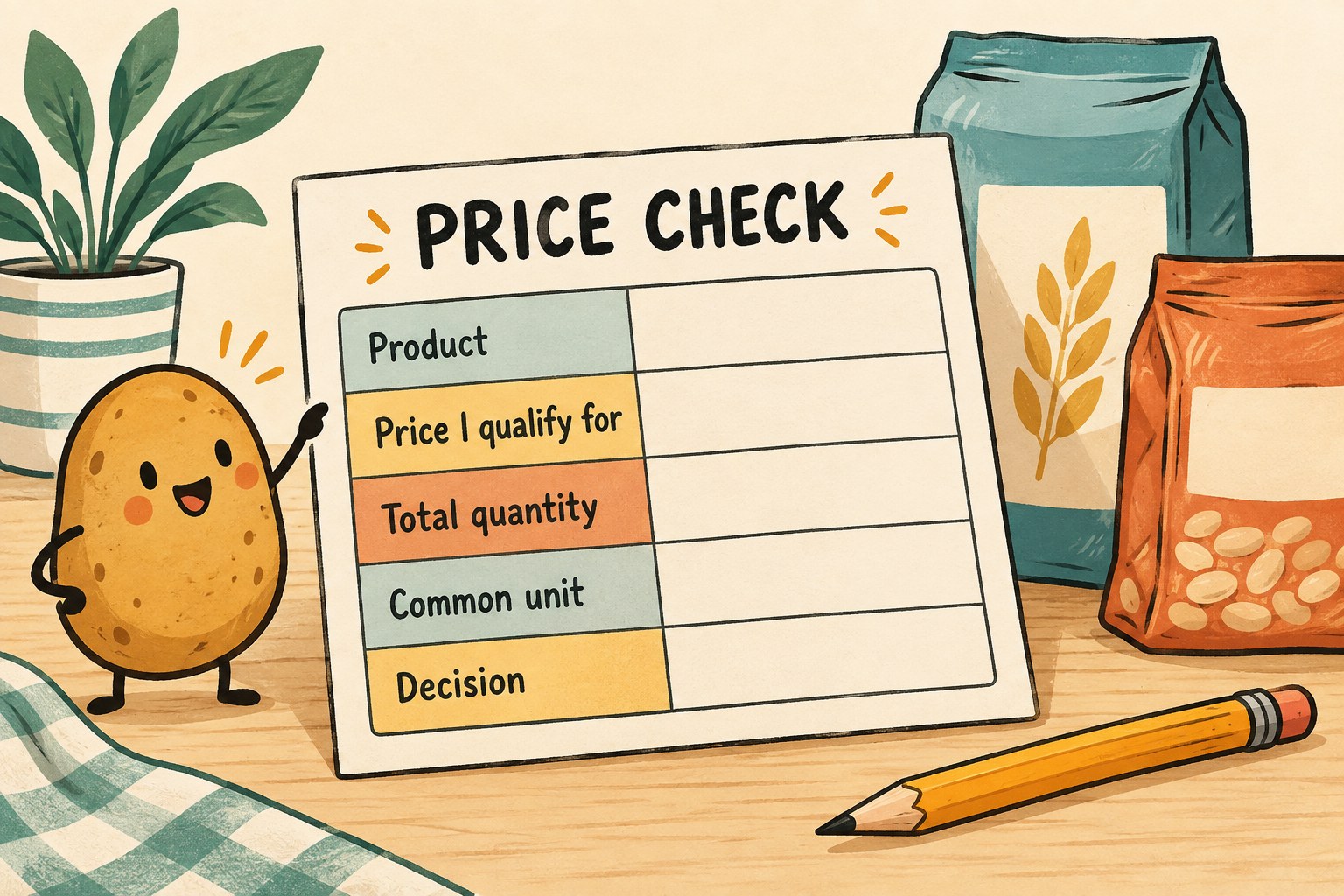
| Field | Option A | Option B |
|---|---|---|
| Product and exact size | Fill in | Fill in |
| Qualifying total price for required packs | Fill in | Fill in |
| Required number of packs | Fill in | Fill in |
| Total quantity in common units | Fill in | Fill in |
| Calculated price per chosen unit | Fill in | Fill in |
| Total purchase cost | Fill in | Fill in |
| Conditions, use and storage check | Fill in | Fill in |
Add the store and date if you plan to reuse the note. Old prices are a record, not a promise. Finish with one sentence: “I chose ___ because ___.” A lower unit price, a smaller total purchase or a better-fitting quantity can each be a clear reason.
The aisle-length version
Same product job. Same measurement. Eligible price. Useful quantity. Check those four things, calculate if needed, and move on. You are buying groceries, not defending a thesis in front of the pasta.