A coding agent changes a component, the snapshot test turns red, and the proposed fix is to update the snapshot. That might be the right fix. It might also be a very efficient way to approve a mistake.
Before accepting the new baseline, make the agent explain each meaningful change against the intended behavior. The useful deliverable is a short review record: what changed, why it should change, and what remains unverified.
Why this is worth checking now
A discussion surfaced on GeekNews on October 6, 2026, about tests generated from buggy code. The underlying Zhao, Zhou and Cohen study was submitted on July 24, not released today. It found that buggy implementations can steer generated unit tests toward incorrect expectations. Its experiments concern Java unit tests, not Jest snapshots, so they do not measure the workflow below.
The practical connection is narrower: do not let observed output silently become the definition of correct output. This guide applies that question to one everyday review decision: whether an AI-proposed snapshot update deserves to be accepted.
Know which evidence you are reviewing
Jest’s snapshot documentation distinguishes serialized-value snapshots from pixel-based visual regression tests. A text snapshot can reveal changed markup or output, but it cannot show every visual or interaction problem.
Updating the reference changes what future runs compare against. Jest recommends reviewing snapshots as code and warns against regenerating them around unintended bugs. Keep that distinction visible in the review: “matches the new baseline” is not the same finding as “meets the intended behavior.”
Start with one changed component and one reason
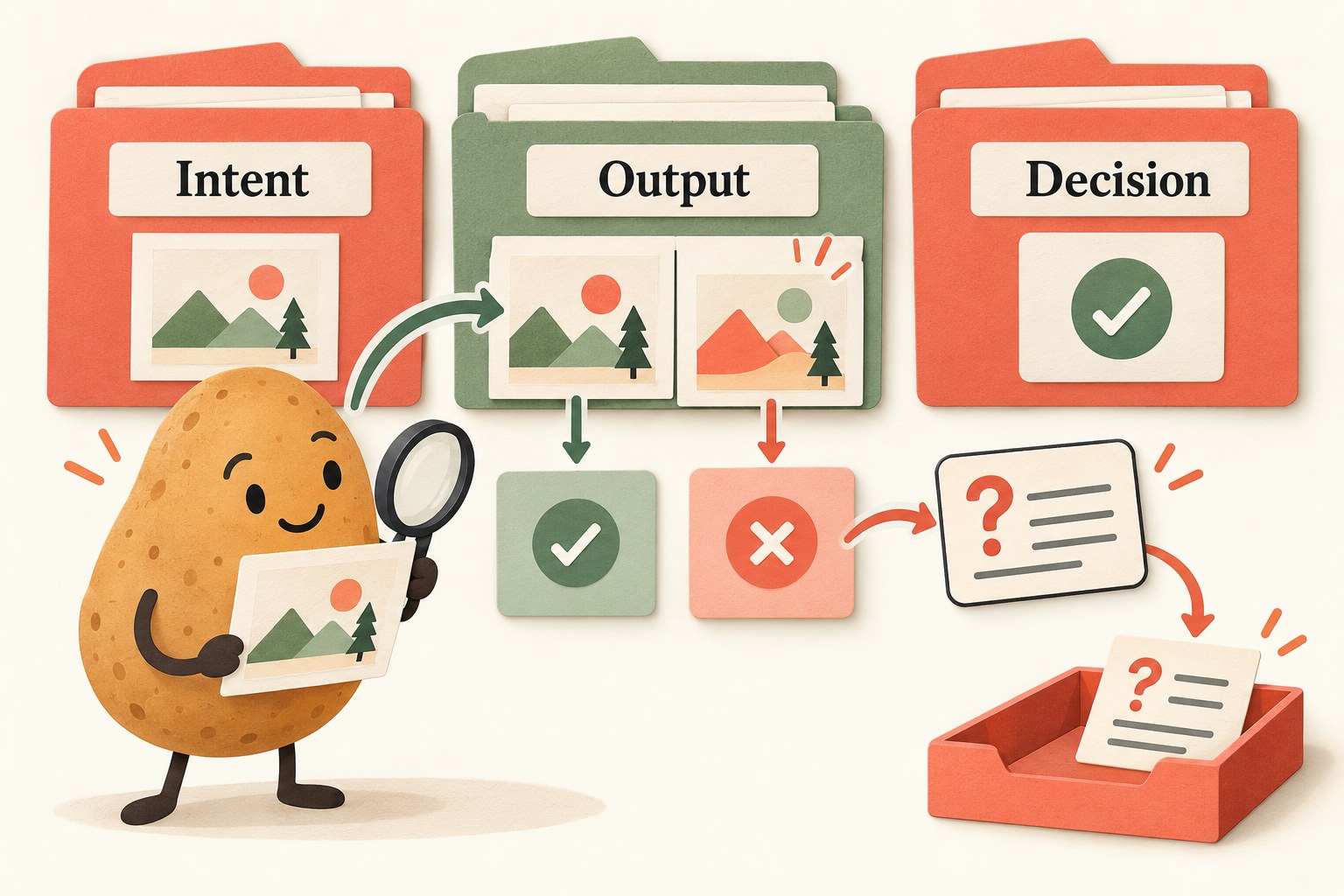
Choose a small change you can explain without reading the implementation. For example, consider an invented saved-list app: when a list is empty, the agreed design replaces “Nothing here” with “Add your first item.” This is a hypothetical example, not a report of a tested product.
Write the reason at the top of the review:
- Intended change: replace the empty-list message.
- Still required: the add-item action remains available; existing items are still shown when the list is not empty.
- Evidence: the approved task description or design, with a specific reference.
- Unknown: any behavior the task did not settle.
A vague instruction such as “clean up the UI” is not enough to approve the disappearance of a button. Ask the responsible person or clarify the requirement before treating that disappearance as the new expected state.
Sort the diff before changing the baseline
| Observed change | Question to resolve | Next step |
|---|---|---|
| Empty-state text changed as requested | Does the new wording match the approved intent? | Candidate for acceptance after checking the relevant state. |
| Add-item action disappeared | Was removal requested, or did the component stop rendering it? | Investigate; do not absorb it into the text-only change. |
| Generated identifier changed | Is it irrelevant test variability or a meaningful identifier? | Stabilize only the irrelevant variability. |
| Several unrelated branches changed | Did a shared fixture, serializer or dependency change? | Explain the common cause or separate the changes. |
| The reviewer cannot explain a line | What evidence is missing? | Leave it unresolved instead of guessing. |
This is a proposed review aid, not a scoring system. A change can be legitimate without being in the original brief, but it needs an explicit explanation before acceptance.
Give the agent a bounded review request
Use this template before asking for any update:
Review the changed snapshots without modifying their expected output.
For each meaningful difference, report:
- the test name and changed value;
- the intended behavior and its independent source;
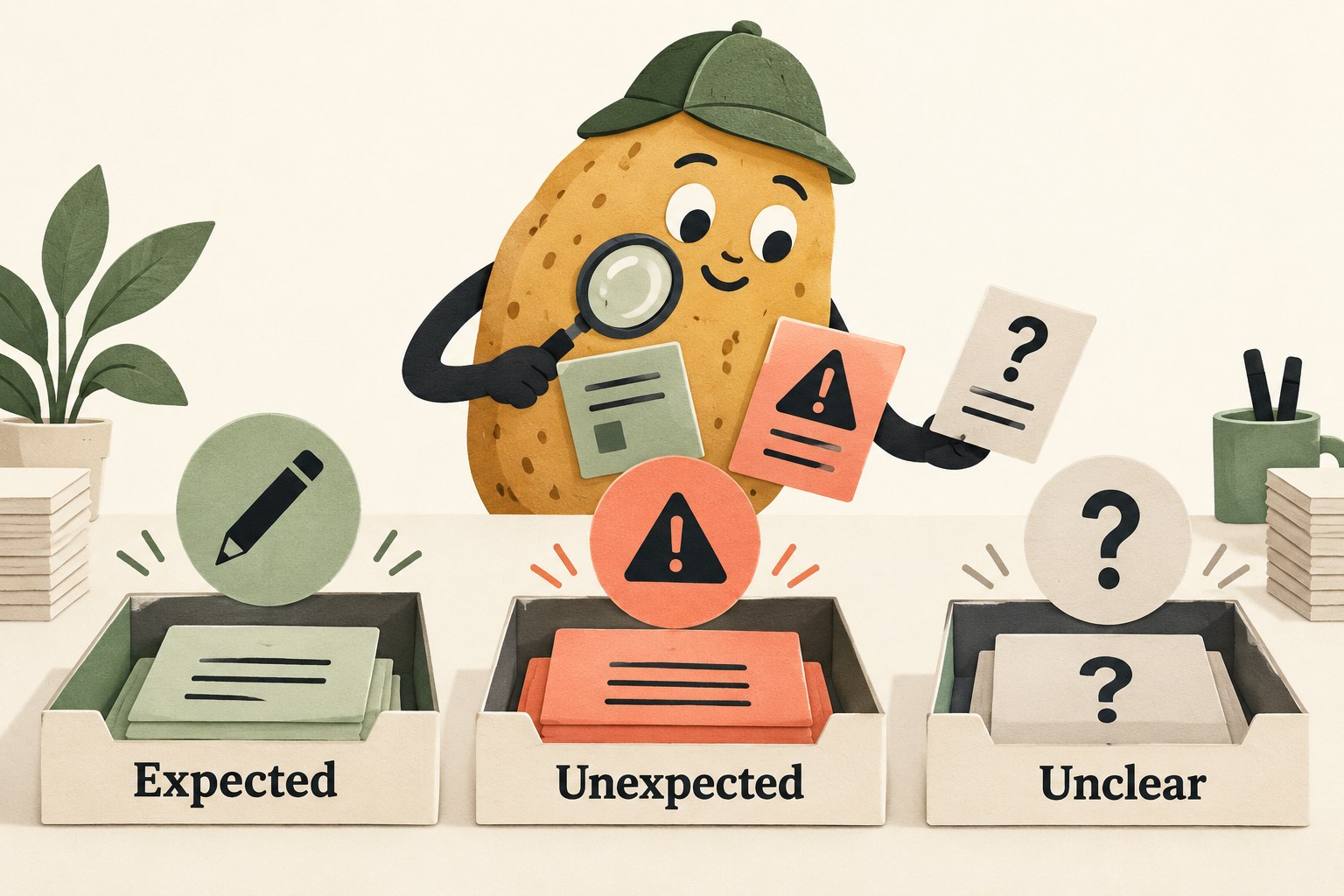
- whether the difference is expected, unexpected or unresolved;
- the smallest check that would resolve it.
Do not infer intent only from the current implementation.
Do not remove assertions, broaden matchers or update baselines
just to make the run pass. Report missing requirements explicitly.
The word “independent” matters. A model’s paraphrase of the changed code is still based on that code. A requirement can itself be wrong or incomplete, so disagreements need a decision rather than a more confident paraphrase.
Check the behavior outside the captured output
For the saved-list example, an appropriate review might inspect both empty and populated states, then exercise the add-item action in a suitable test environment. Record which checks actually ran. Do not turn a proposed check into a passing result in the review note.
Ask what this particular snapshot leaves out. It might capture text but not keyboard activation, one component but not the surrounding page, or an initial state but not the response after saving. Choose additional checks for the specific omitted risk; an enormous new test suite is not automatically a better answer.

Accept the smallest explained update
Keep the update narrow enough that someone else can connect it to the reason. Separate unrelated cleanup from the behavior under review. If the diff is too large to inspect, reduce the captured surface or split the proposed change before accepting it.
For Jest, a broad --updateSnapshot run can update failing snapshots across the selected run. The documentation describes narrowing with --testNamePattern or reviewing snapshots interactively. Check the selected tests and the resulting diff; a filter is not a substitute for review.
Once the expectations are intentionally updated, rerun the relevant tests without snapshot-update mode. Keep the reviewed snapshot and corresponding code change together. If a failure remains, diagnose it rather than repeatedly refreshing the baseline.
Keep a five-line review receipt
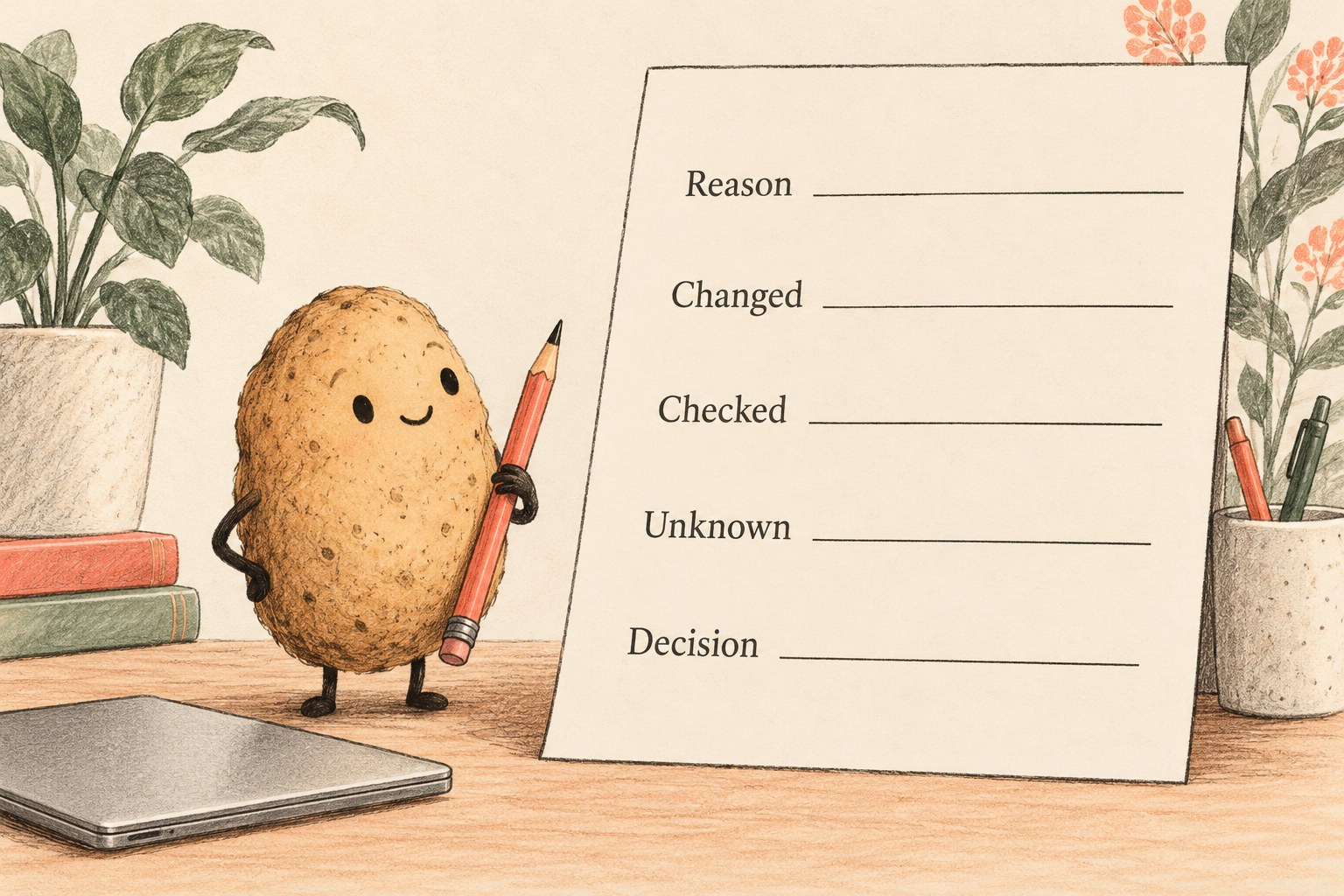
Reason: [approved change and reference]
Changed: [test names and meaningful expected-output changes]
Checked: [commands/actions actually run and observed results]
Unknown: [unrun checks, missing requirements or unresolved differences]
Decision: [accept / revise / hold, with reviewer and date]
For example: “Text change matches the brief; empty-state rendering checked; add-item interaction not yet checked; hold.” That is more useful than a green badge whose scope nobody can explain.
If you need to settle the intended behavior first, use the one-rule brief. If the agent is reporting a defect rather than proposing a baseline update, use the finding-validation checklist. Here, the finish line is specific: every accepted expectation change has a reason, and every remaining uncertainty stays visible.