A duvet cover should suit the insert you already own, but matching the word “Queen” is not a complete fit check. Record the cover and insert dimensions separately, keep measured sizes distinct from advertised sizes, and check whether the maker intends that particular pairing. Equal numbers are useful evidence, not a universal rule.
The shopping mistake is easy: one product page says “Full/Queen,” the other says “Queen,” and your brain stamps the paperwork approved. Your duvet has not signed it.
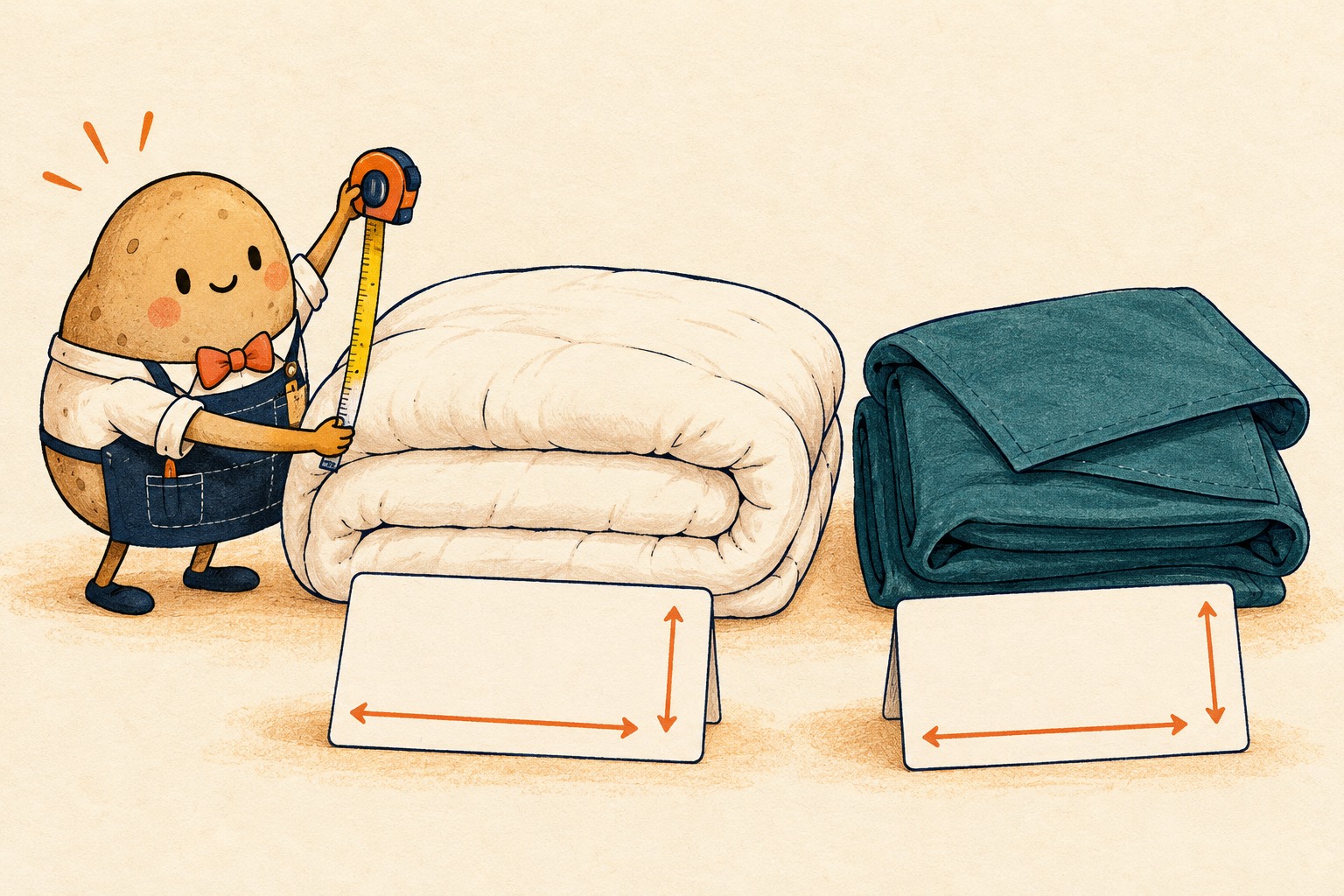
Start with the pairing, not the mattress label
A mattress size describes the bed. A duvet-cover size describes another product. Do not copy mattress width and length into the space reserved for your insert.
There is also no universal rule that an insert and cover must have identical published dimensions. In its official dimensions FAQ, Brooklinen lists a 90 × 90-inch Queen duvet cover and a 92 × 96-inch Full/Queen comforter. Those are that maker’s listed figures, checked October 9, 2026, not a chart for all brands or proof of how your existing items fit.
The Company Store’s duvet-cover guidance also allows a slightly larger insert for a loftier appearance. “Slightly” is not a universal allowance you can apply to every filling, fabric or brand. If you are mixing products, ask about the exact models and dimensions rather than choosing a larger size by name alone.
Make a two-item record before buying
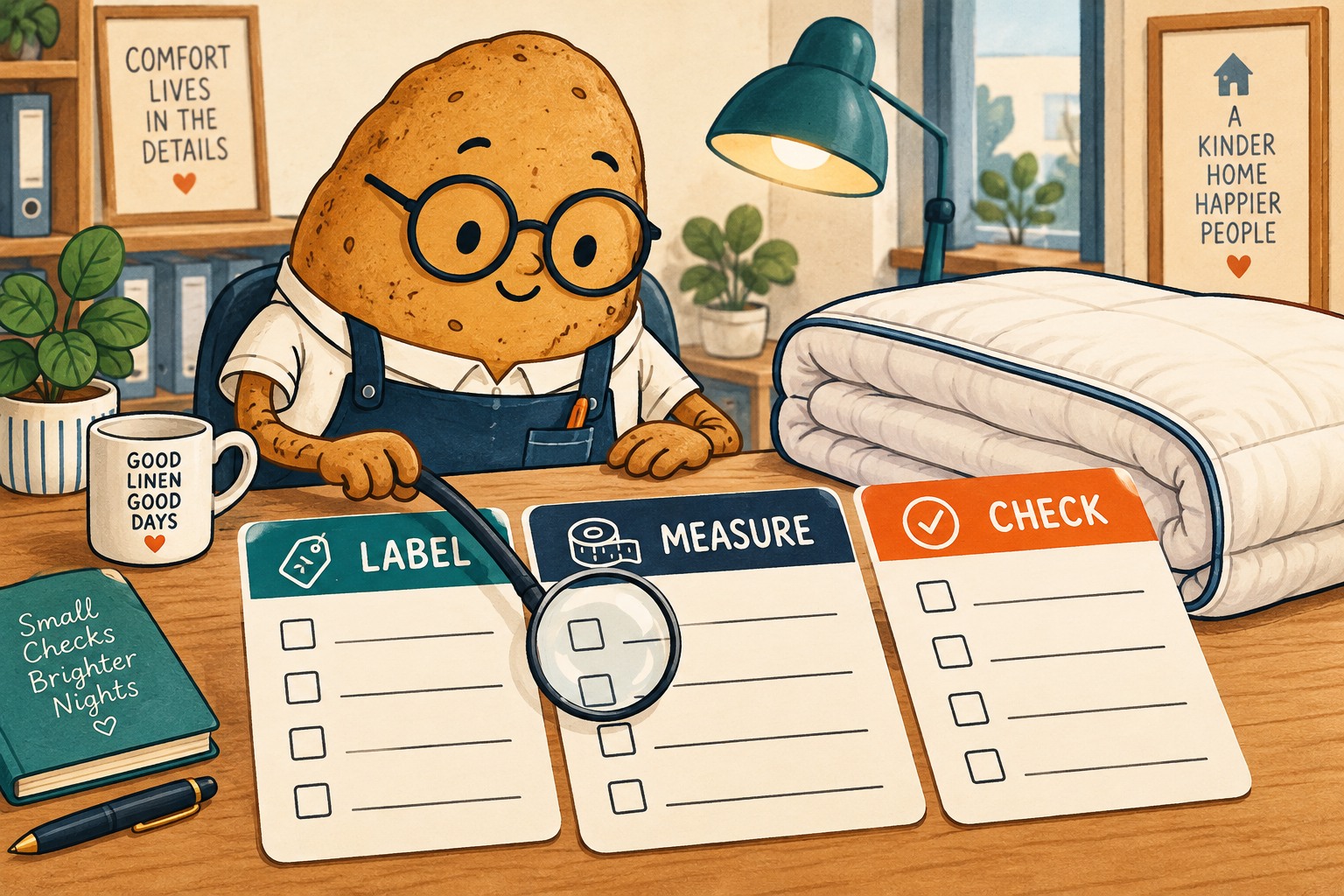
Use a tape measure, the existing insert label and the candidate cover’s exact product page. If your insert is already inside a cover, remove it so you are not measuring two layers as one item. Work on a clean surface large enough to lay the item out.
- Identify the insert. Record its brand, model, named size and label dimensions. If the label is unreadable, write “unknown”; do not silently replace missing information with a standard-size chart.
- Measure the current item. Lay it flat, gently settle wrinkles without pulling it taut, and measure edge to edge across both axes. Repeat any uncertain reading. Record this as your measurement, with the date and unit.
- Identify the cover. Record the selected variant, listed dimensions, country/storefront and product link. Confirm whether dimensions refer to the finished cover or another part of a set.
- Keep the orientation consistent. Label the axes width and length. For a rectangular cover, note which edge has the opening and whether a directional pattern restricts rotation.
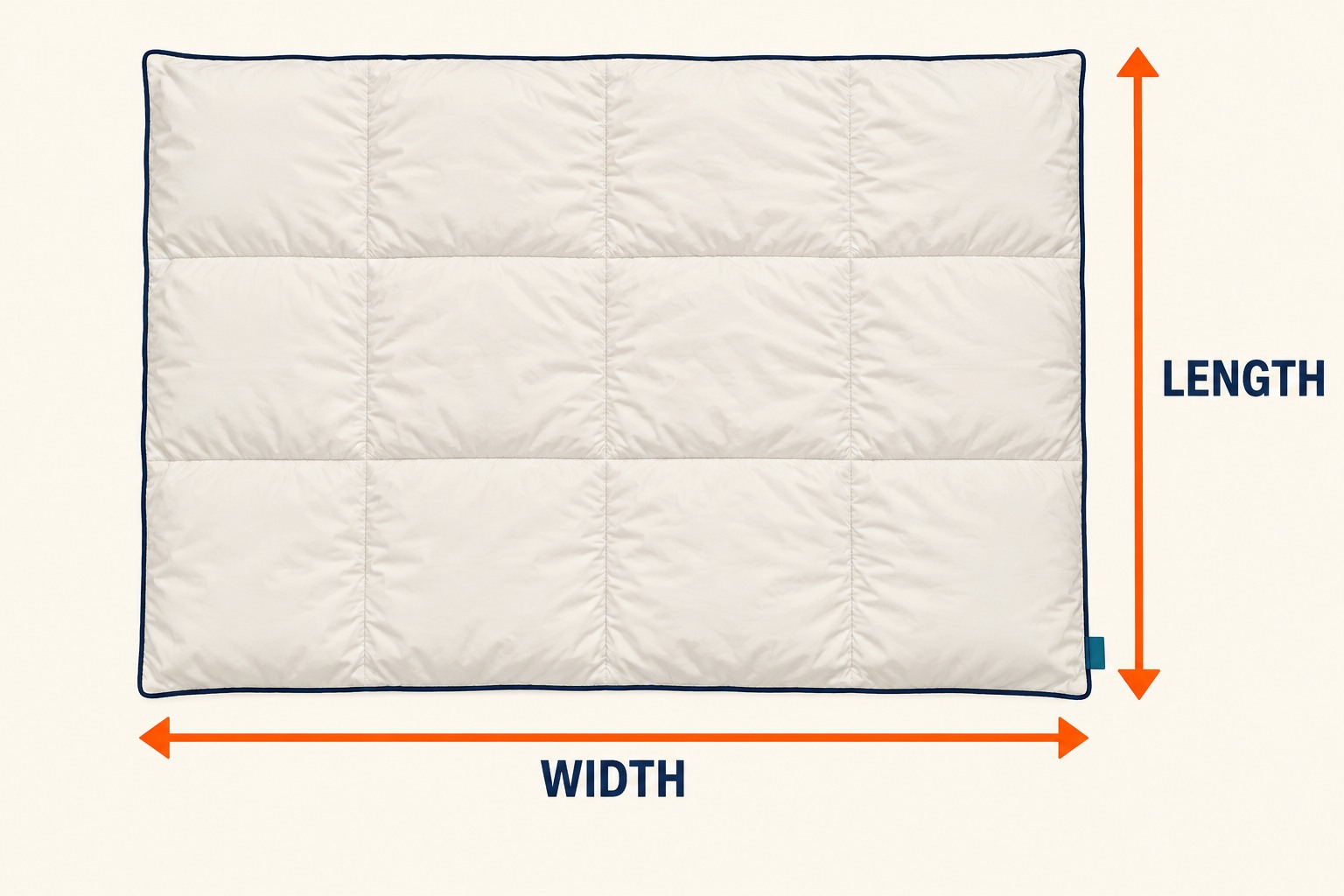
If the measured insert differs from its label, retain both values. Different measurement technique, the item’s condition or a specification difference may need checking; a single measurement does not prove shrinkage or a faulty product. Do not promise yourself that laundering will fix a mismatch.
Use signed differences as questions, not a pass mark
For each axis, subtract the insert dimension from the cover dimension, using the same unit and the same type of evidence. A positive result means the cover number is larger; a negative result means it is smaller. Label the calculation as listed-to-listed or measured-to-measured. Comparing a measured used insert with a new cover’s listed size is a preliminary shopping check, not a controlled fit test.
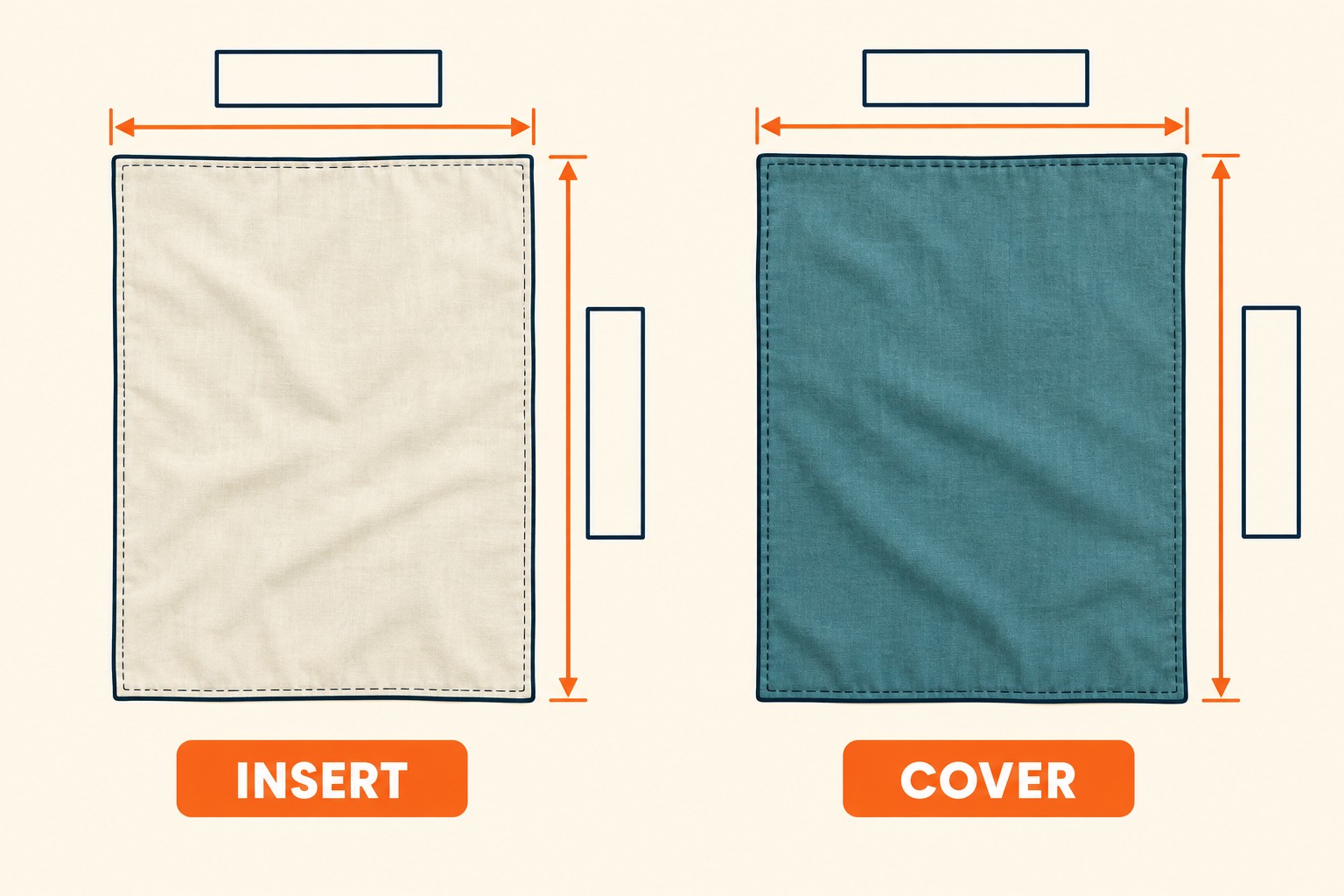
| Item | Width | Length | Evidence |
|---|---|---|---|
| Insert | 220 cm | 240 cm | Hypothetical product label |
| Cover A | 220 cm | 240 cm | Hypothetical product listing |
| Cover A minus insert | 0 cm | 0 cm | Listed-to-listed comparison only |
| Cover B | 230 cm | 220 cm | Hypothetical product listing |
| Cover B minus insert | +10 cm | −20 cm | Wider on one axis, shorter on the other |
Cover A matches the numbers but still needs the construction and maker checks. Cover B is not simply “a bit bigger”: it differs in opposite directions. Rotating it is not automatically a solution; check the opening, pattern and intended orientation first. Do not turn a total difference into an exact empty margin on each side: a filled duvet is not a rigid sheet of plywood.
Check the corners and closure too
Look for the cover’s internal ties or other supplied attachment system and the insert’s matching loops or attachment points. Count and locate them on the actual products. The Company Store notes that comforters used inside covers may lack corner ties, and that closures can be buttons or zippers. A fastening check is separate from the size check.
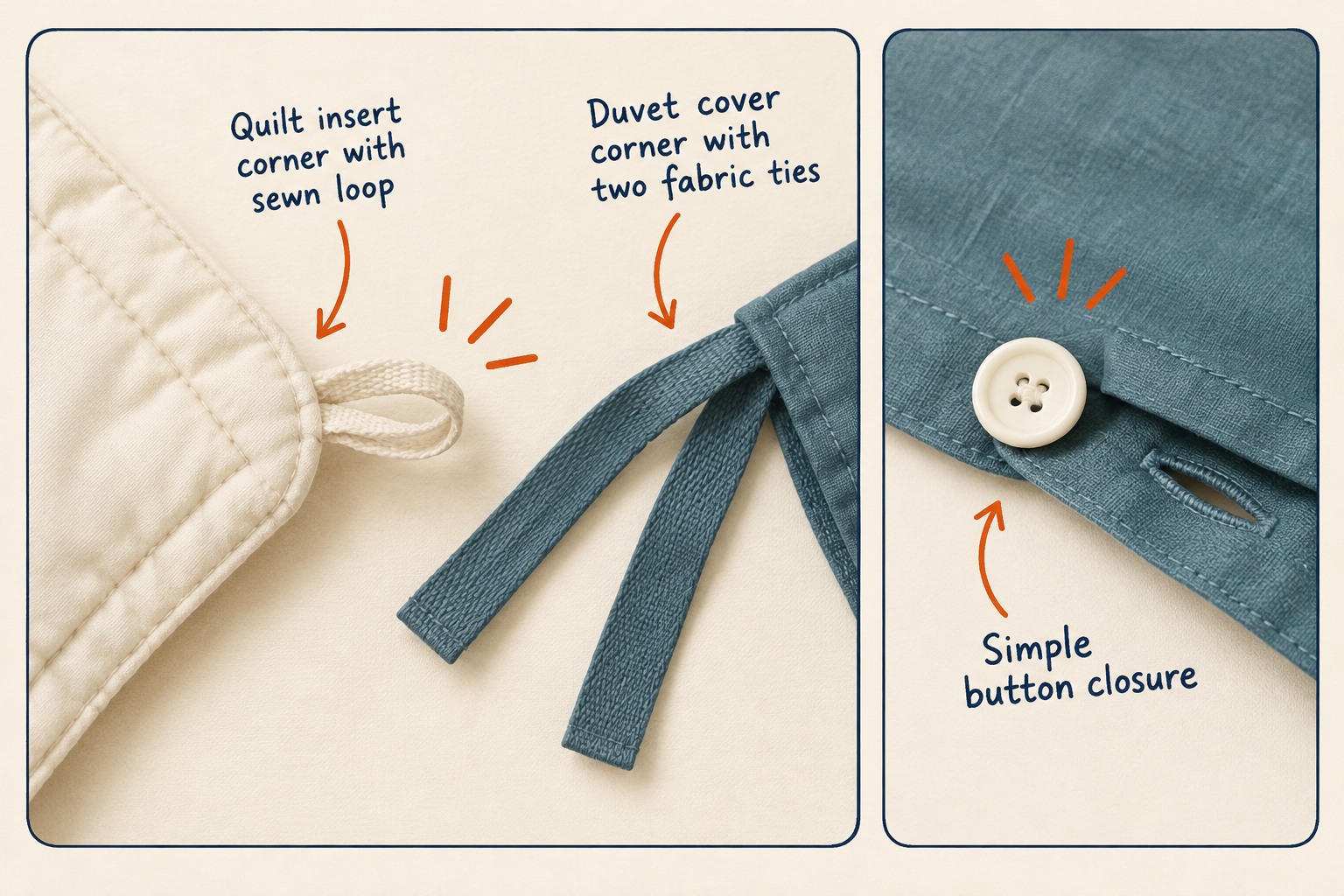
- Does the cover’s opening let you insert and remove this duvet without forcing it?
- Do the available attachment points correspond? An absent loop should be recorded, not invented because the listing says “duvet.”
- Can the supplied closure close normally once the insert is distributed?
- Do the care instructions suit how you will maintain the pair? Read each label separately.
Use attachment systems as their maker directs. This guide does not recommend adding pins, improvised clips or new sewing as a substitute for resolving an uncertain pairing.
Copy this cover-and-insert fit card
Keep one record per candidate so that a browser tab change does not accidentally change the size you meant to buy.
| Record | Your entry |
|---|---|
| Existing insert: brand / model / named size | ________________ |
| Insert label width × length, with unit | ________________ |
| Insert measured width × length, date and condition | ________________ |
| Candidate cover: exact variant / storefront / link | ________________ |
| Cover listed width × length, with unit | ________________ |
| Width difference / length difference / evidence types | ________________ |
| Opening edge / pattern direction / attachments | ________________ |
| Maker’s pairing guidance or unanswered question | ________________ |
| Care instructions and return conditions checked | ________________ |
| Decision: suitable to try / ask first / choose another | ________________ |
What to ask when the numbers disagree
Send the seller a specific question: “My insert is [brand/model], labelled [width × length, unit], and currently measures [width × length]. Does your [exact cover variant] suit it? Are the listed dimensions intended before or after the recommended wash, and what attachment points does the cover have?”
Before ordering, check the actual return conditions, including whether opening, washing or trying bedding affects eligibility. Do not assume every store accepts a washed trial. Once you receive it, check the item and its instructions; the comparison card does not override the seller’s care directions.
If a compatible pair still bunches, first check orientation, distribution and any supplied attachments. If one axis remains obviously wrong, return to the two-item record instead of repeatedly buying another product with the same size name.
For other bedding measurements, use our fitted-sheet depth checklist. That is a different fit problem: mattress depth belongs on the sheet record, not in this duvet comparison.
Source note: Product information was checked on October 9, 2026. The worksheet and fictional calculation are original editorial aids; the illustrations are AI-generated concepts, not product photographs or evidence of a hands-on fit test.