“Kitchen stuff” gets a box to roughly the right place. It does not tell you whether it holds the mugs you need tonight or the serving platter you can leave until next week. A useful moving label answers three questions: where does this go, which box is it, and what will I look for first?
This guide is a small household system for labeling and finding boxes. It includes a copyable label, a box register and an arrival check. It is not a packing-strength specification, a mover's inventory form or a replacement for your moving company's instructions.
1. Name the destination rooms before naming the boxes
Write a short room list for the new home, using names a helper can understand without knowing your old layout. “Front bedroom” is more useful than “my room.” If there are two bedrooms or two bathrooms, give each a different name. Match the wording on the boxes, the register and a temporary room sign.
Mayflower’s Packing 101 guide recommends assigning cartons to rooms in the new home and using corresponding signs on the room doors. That shared vocabulary is the starting point.
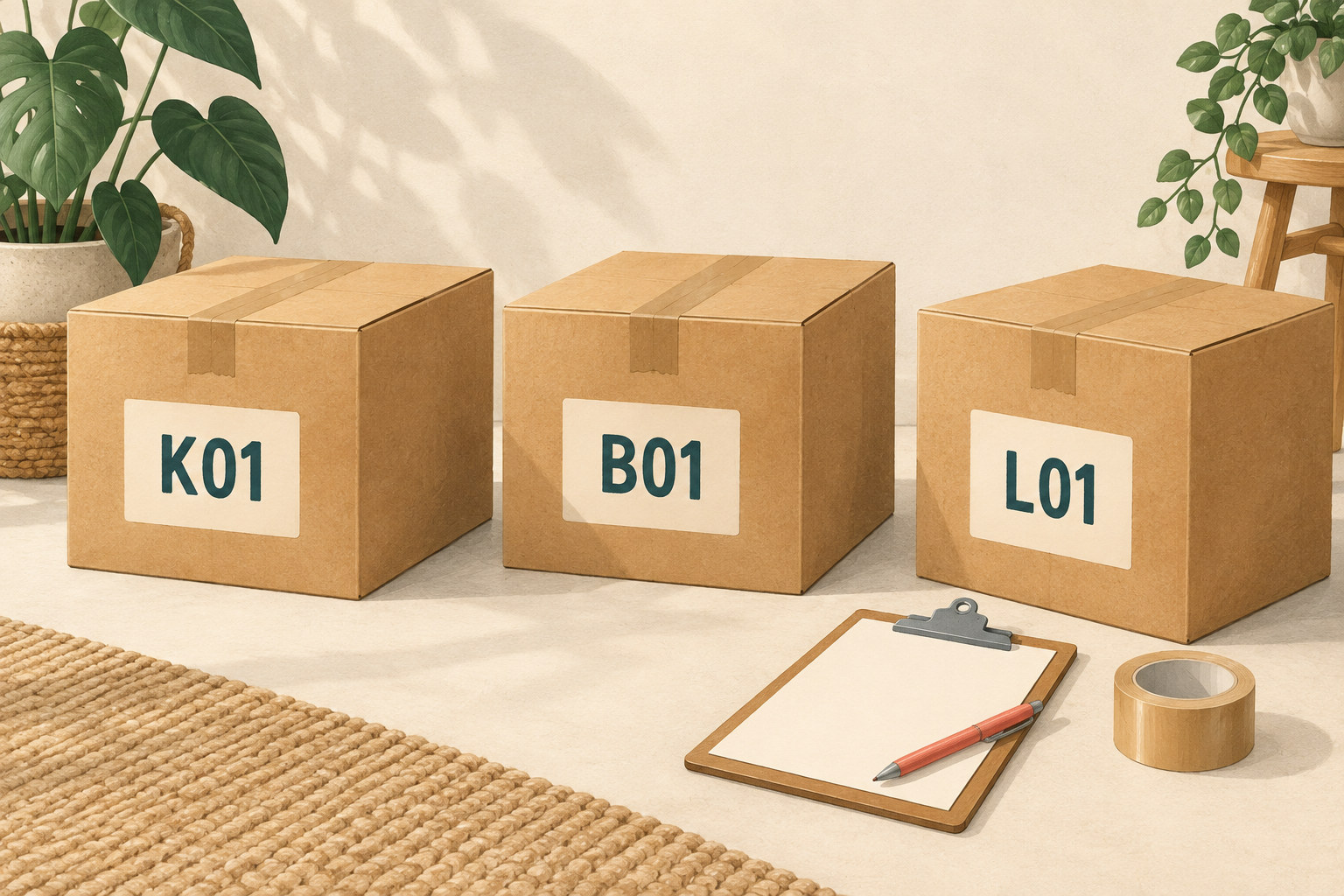
Choose a short code for each destination. The code is a filing aid; keep the full room name on the label as well. For a simple example, use K for kitchen, B for bedroom and L for living room. In a larger home, use more specific codes such as BED1 and BATH1. Do not use B for both bedroom and bathroom.
Color can help people spot a group, but it should be optional. A written room name still works when a marker runs out, someone cannot distinguish the colors or the label is viewed in a dim hallway. You do not need matching stationery to make the system usable.
- Write the destination room list.
- Choose one distinct code per room.
- Show the same room names to everyone helping.
- Keep doorways, walkways and access to controls clear; a room label is not permission to put a box anywhere in that room.
2. Give every box one ID and a useful contents line
Number boxes as you pack them: K01, K02, K03 and so on. Each ID belongs to one box across the whole move. Keep that ID if the box is redirected to a different room; update its written destination and register entry instead of creating a second identity. In that case, the updated full room name controls the destination; the old prefix is just part of the permanent ID.
The contents line should name the things you would search for. Replace “miscellaneous” with “mugs, tea, teaspoons.” If a box genuinely mixes categories, list the most useful items in the register rather than making the outside label unreadably dense. Keep personal details and descriptions of documents or valuables off exposed labels.
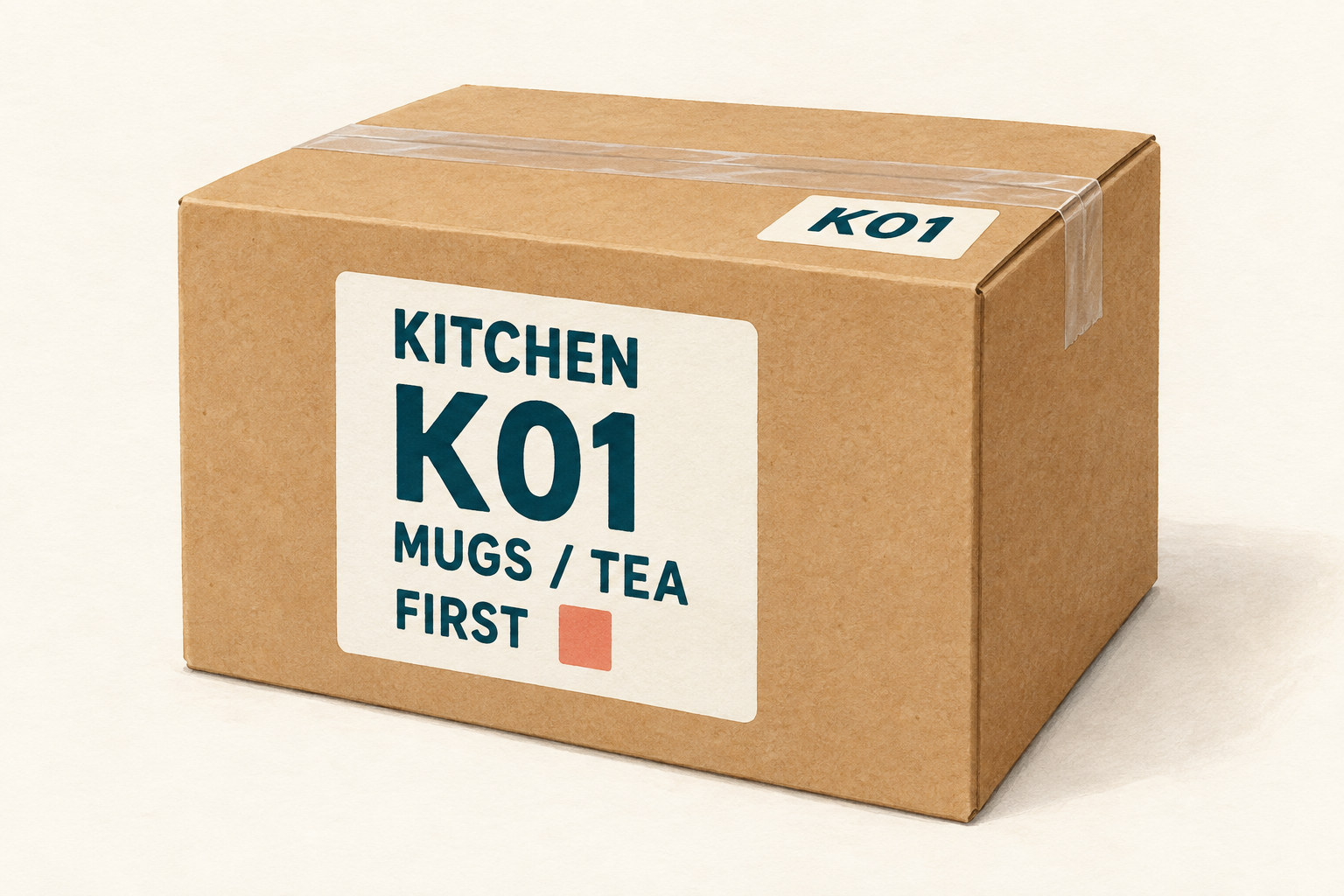
Use the following original label template. Here, FIRST means “open early after arrival.” It does not mean “load first,” does not identify fragile contents and does not tell a helper how much the box weighs.
- Destination: KITCHEN
- Box ID: K01
- Find inside: MUGS / TEA / TEASPOONS
- Open: FIRST
U-Haul’s U-Box organizing guide recommends room-and-priority labels and a small inventory of must-find items. The two-level version below is our simplified household worksheet, not a requirement imposed by every mover.
Use just two unpacking priorities to start: FIRST and LATER. Mark FIRST only when you can name something in that box that you expect to need soon after arrival. If every box is FIRST, the label stops helping. Handling instructions such as those required for delicate contents are separate; follow the packing and labeling guidance that applies to the item.
Allied’s room-by-room packing guide recommends a room label on the top and at least one side. Repeat the same ID and destination there so you have more than one place to look when one face is obscured. Do not rely on the top alone. Check that the marker or label will remain legible on that surface. Keep any moving-company labels visible, and use the mover's required documentation alongside this household system.
3. Keep a simple box register
Mayflower also recommends keeping a master contents list in a safe place and optionally numbering or coding cartons. A register is the bridge between “Where are the mugs?” and “Look for K01.” Use one paper sheet or a simple note that you can access without unpacking the computer. Record the row before the box disappears into a stack. A private backup photo of the sheet can be useful; it does not need to become a public moving-day post.
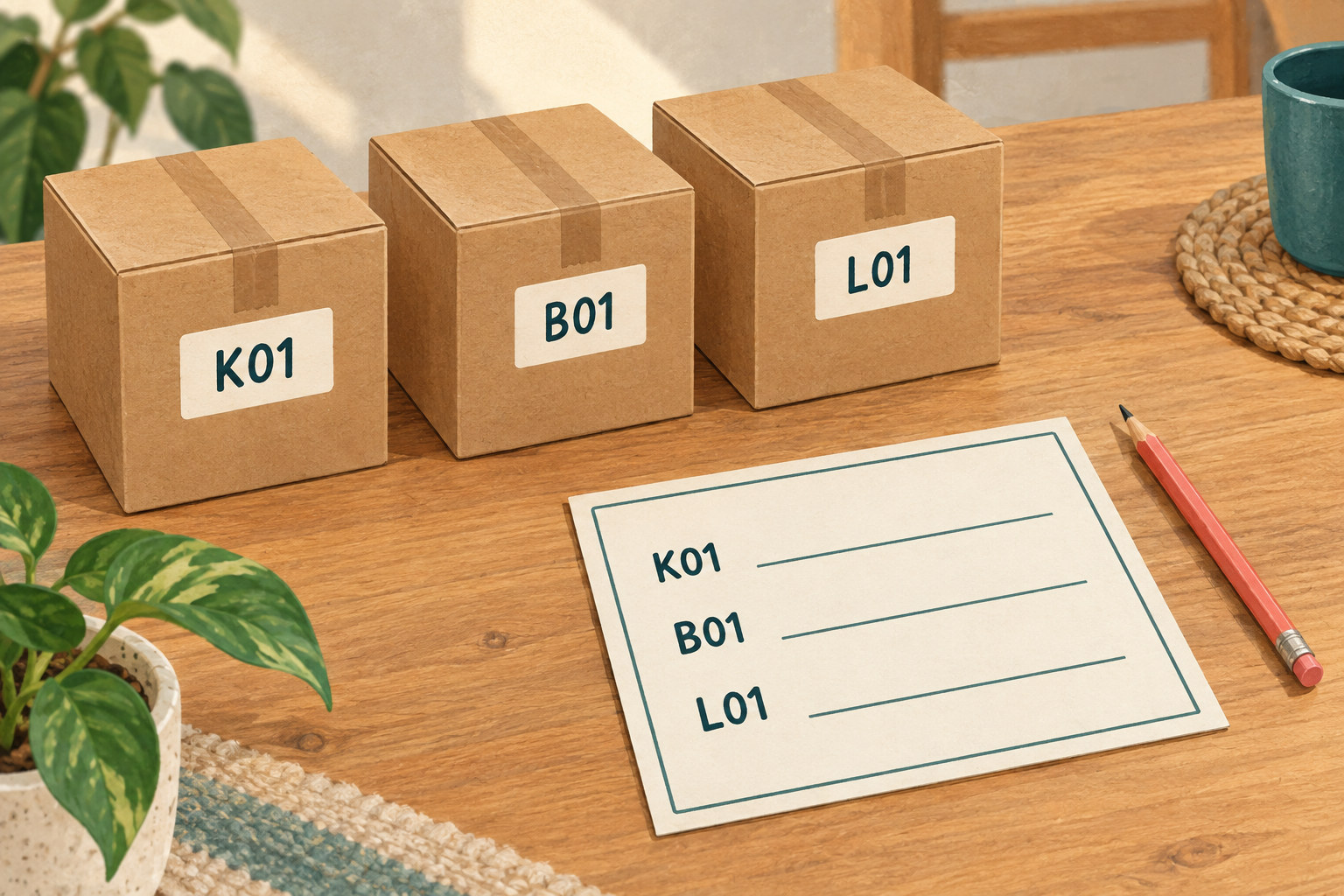
| Box ID | Destination | Useful contents | Open | Status |
|---|---|---|---|---|
| K01 | Kitchen | Mugs, tea, teaspoons | FIRST | PACKED |
| B01 | Bedroom | Pillowcases, clean sheets | FIRST | PACKED |
| L01 | Living room | Paperbacks | LATER | PACKED |
These three rows are an invented example, not a recommended number of boxes or a tested moving inventory. Add your own rows and a simple status beside each: PACKED, RECEIVED or OPENED. RECEIVED means the identified box reached the new home; it does not mean every item inside has been checked.
Choose one person to maintain the master list when several people are packing. Helpers can send them a box ID and contents line. If two people accidentally use K03, fix the duplicate on the box and in the register before those boxes leave. If a box is reopened and its contents change, update that same row. If you split its contents between two boxes, give the additional box a new unused ID and record what moved. An accurate short list is more useful than a detailed list that describes yesterday's boxes.
4. Separate what you need before any box is opened
Mayflower’s moving-preparation advice recommends transporting essential items separately yourself. The FIRST label is for an early-unpacking box. A carry-with-you essentials bag serves a different purpose: you can reach it before boxes have been delivered, sorted or opened. Keep the two systems distinct.
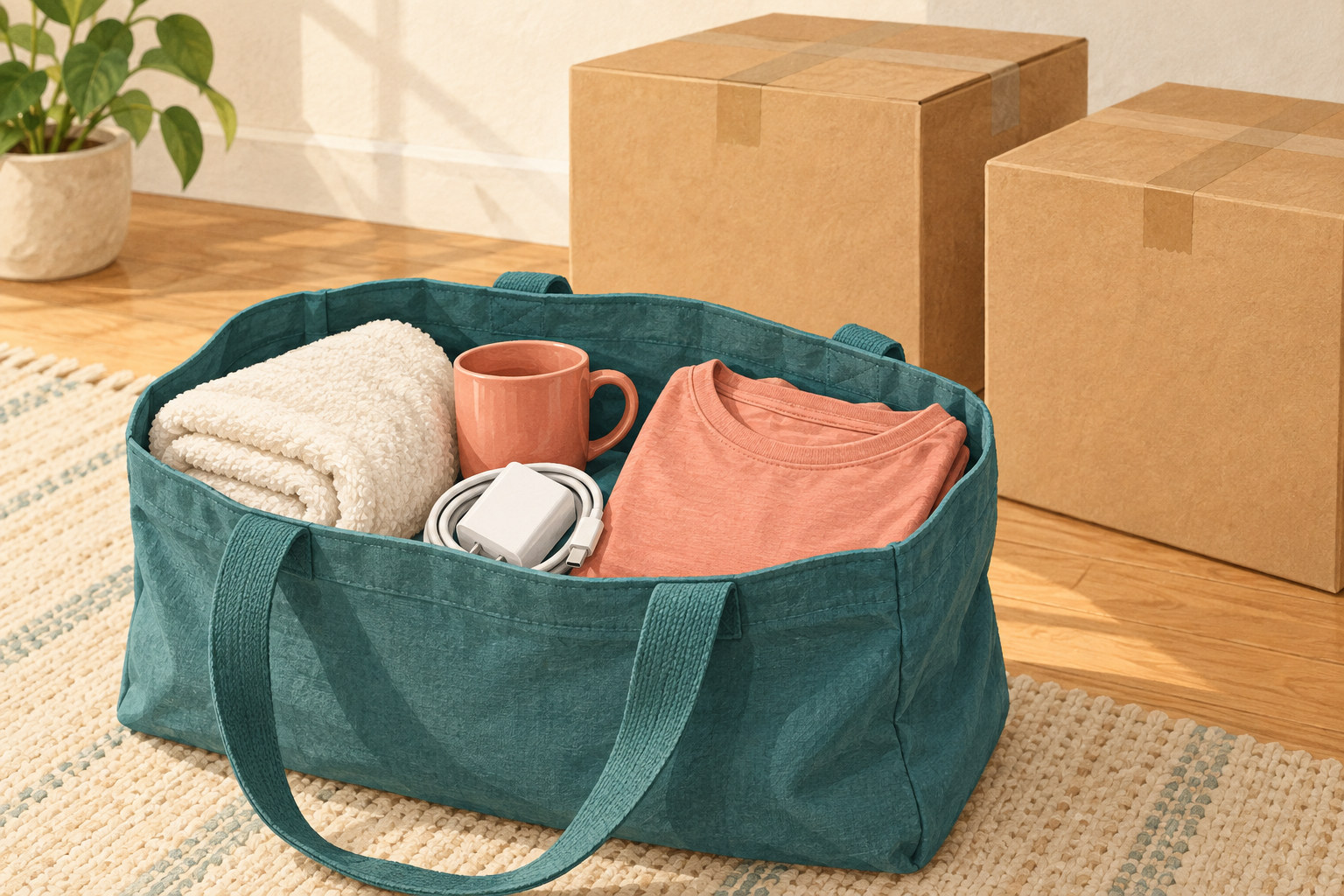
Make a short list for the actual gap between leaving the old home and settling into the new one. Ordinary examples include a phone charger, a clean shirt, a towel and a few personal essentials. Adjust for your own household and journey. Decide who carries the bag and where it will stay; do not leave it beside sealed boxes and assume everyone knows it is separate.
Write “WITH ME” on your own packing note rather than assigning the bag an ordinary box ID. In the example above, the box tally is three and the separately carried bag tally is one. Keep important documents and valuables under your own appropriate arrangements, and check the mover's rules for items it cannot carry. This guide does not establish what a particular company will accept.
Before closing a FIRST box, ask: “Will I need any of this before I can reasonably open the box?” If the answer is yes, move that ordinary essential to the carry-with-you bag and correct the register. This is easier than digging through a stack because the charger went into the right room but the wrong container.
5. Check identity at arrival, then check contents when opening
Use the room names to direct each box, then tick its ID as received. Count identified boxes rather than relying only on a total. Three boxes arriving does not establish that K01, B01 and L01 arrived if two labels accidentally say K01.
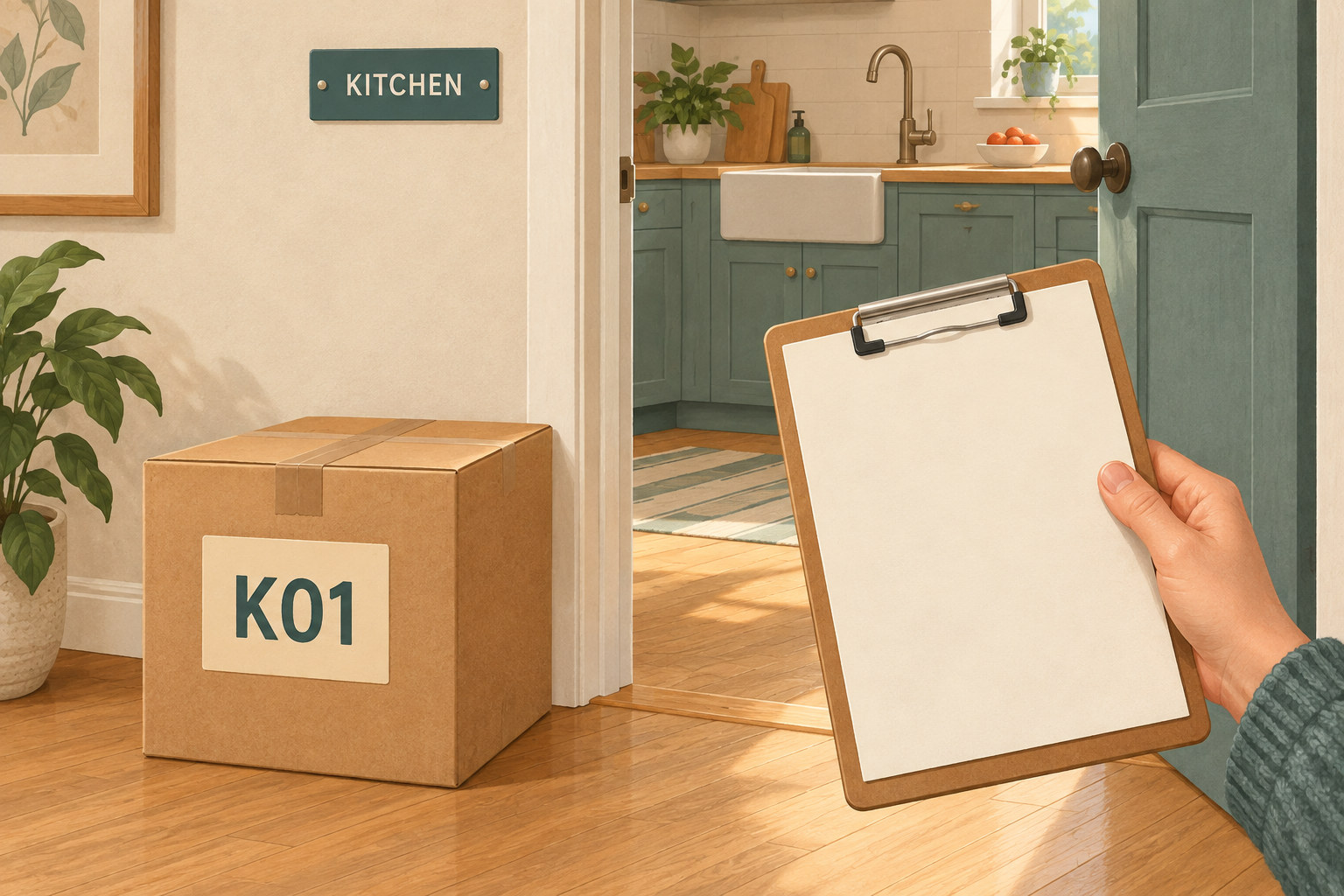
If a box is not where expected, start with the register and the destination rooms. Look for the exact ID, including on the other visible face. Ask the person coordinating the move before assuming it was lost. Record an unresolved discrepancy clearly and follow your mover's own reporting process where applicable; a household checkbox is not a substitute for their paperwork.
Open the FIRST boxes when it is practical, check the contents against their rows, then mark OPENED. When changing a box's location, update the register so the next person does not repeat the search. Leave the old ID visible until the box's job is finished. For boxes reused later, remove or clearly cross out obsolete household labels before assigning a new identity.
A copyable moving-label finish check
Use this short card for each box before it joins the packed stack:
- One unique box ID: ______
- Full destination room name: ______
- Specific contents I will look for: ______
- FIRST or LATER, with a reason for FIRST: ______
- ID and room visible on top and side: checked / fix
- Matching register row: checked / fix
- Carry-with-me items removed from this box: checked / not applicable
At arrival, add “received at destination” and later “opened and checked.” The goal is a trail you can follow from an item name to one box, and from that box to one room. Start with the next box you pack; there is no need to redesign the whole move before writing a useful label.
Sources and scope
The linked Mayflower, Allied and U-Haul guidance was checked October 6, 2026. The label, example rows and status definitions are original planning aids, not results from a hands-on moving test or an official mover form. Illustrations are AI-generated concepts, not photographs of a completed move.