To clean suitcase wheels, check the model’s care instructions, brush away accessible debris, use only an approved wiping method, and let the wheel area dry completely. Then compare each corner’s rolling and swiveling movement with your starting notes. A cleaner wheel is not proof that a crack, loose housing or persistent jam has been repaired.
A suitcase can look ready for another holiday while one corner has quietly voted to stay home. Instead of spraying every moving part and hoping, give each wheel assembly a name, a gentle check and a short record. This guide focuses on attached spinner wheels, not shell cleaning or wheel replacement.

Give the corners names before moving the case
Empty the case and choose a clear, flat indoor area. Keep your workspace stable and comfortable; do not balance a heavy case precariously to reach underneath. Read the maker’s instructions for your model before choosing a cleaner or changing its position.
Take a reference photograph with the front facing you. In your own note, assign A and B to the near corners and C and D to the far corners, describing left and right as seen in that photograph. These are your tracking labels, not universal replacement-part codes. A pair of small wheels sharing one housing counts as one corner assembly in this record.
This detail matters when you later ask for help. Samsonite’s parts FAQ, for example, uses a logo-facing orientation and asks which front or rear corner needs attention. It also says parts are collection-specific rather than universal. Use your manufacturer’s identification convention when contacting support, even if your personal note uses A–D.
Separate rolling from swiveling
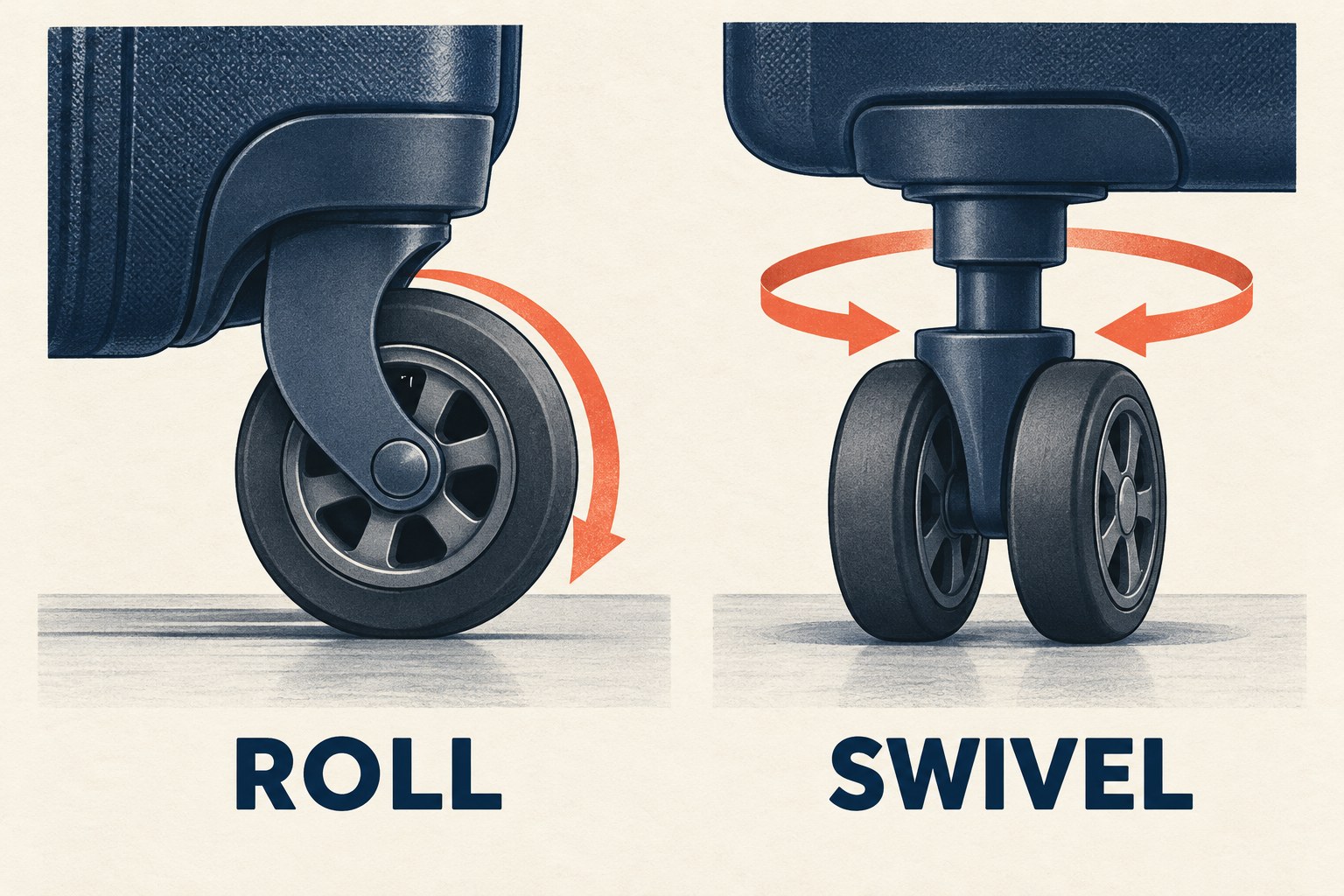
There are two observations to make. Rolling is the tire turning around its axle. Swiveling is the whole caster changing direction beneath the case. A wheel can do one while resisting the other. Fixed two-wheel luggage does not have the same swivel check; mark that field “not applicable” rather than treating it as a fault.
Before cleaning, gently observe each accessible assembly without forcing it. Write “moves freely,” “catches,” “does not move,” or “uncertain” in separate roll and swivel fields. If you notice noise, describe it in another note. Do not turn a squeak into a diagnosis of a failed bearing.
For a whole-case comparison, choose one short, clear path and a gentle turn. Use the same floor and the same contents before and after; an empty case is a simple baseline. Note any difference from your usual packed travel conditions. This is an editorial observation method, not a laboratory test, load rating or manufacturer inspection.
Clean the accessible area, not the inside of a mechanism
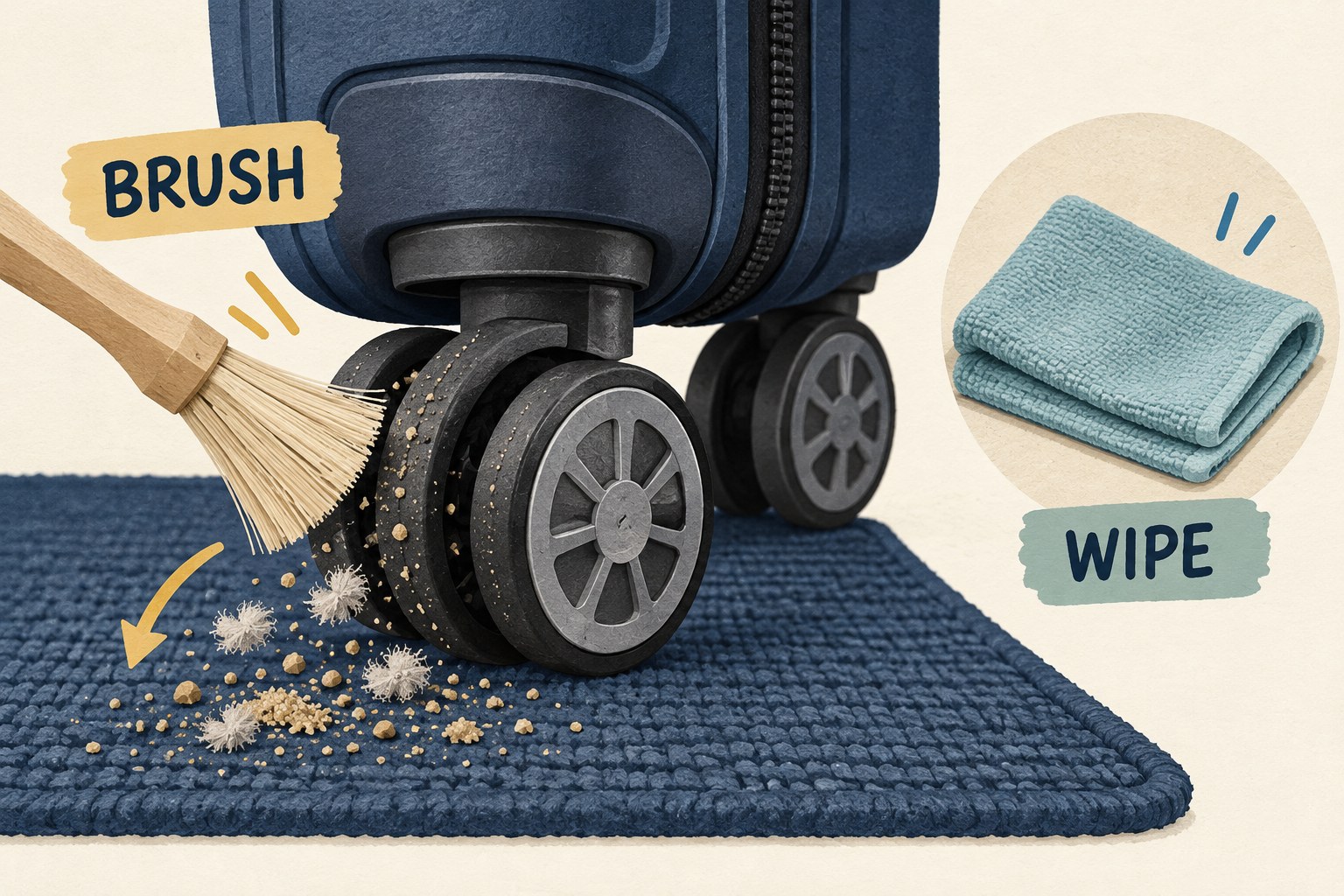
DELSEY’s spinner-wheel care guide describes removing surface debris with a soft brush, wiping with a cloth and mild soapy water without soaking, then drying fully. Treat that as a manufacturer example, not permission to apply the same cleaner to every brand, finish or component.
- Start dry. Brush loose grit and fluff from reachable surfaces onto a protective mat. Collect what comes off rather than redistributing it around the case.
- Check the permission for wiping. Use your model’s approved method and keep liquid controlled. Do not immerse the suitcase or flood a wheel assembly.
- Inspect what remains. Record inaccessible wrapped material rather than inserting a blade or forcing a tool into the axle gap. If ordinary accessible cleaning does not resolve it, move to the model’s service guidance.
- Finish drying before the comparison. Remove remaining moisture with a suitable dry cloth and allow the cleaned area to dry fully. Do not invent a universal drying time.
Keep lubricant and dismantling outside this basic routine. DELSEY discusses them separately, with removal conditional on the suitcase allowing it. That is not a blanket instruction to remove any wheel or use whatever spray is nearby. Follow model-specific maintenance instructions if those steps are actually needed.
Copy this four-corner record

The illustration is a blank visual reminder; the text below is the usable record. Leave unknowns as unknowns. There is no required spin time, improvement percentage or pass score.
- Date and model: ______
- Reference photo and orientation: ______
- Floor and short comparison path: ______
- Contents kept the same: ______
- Care instructions checked: ______
| Corner ID | Before: roll / swivel | Debris or visible damage | After drying: roll / swivel |
|---|---|---|---|
| A: ______ | ______ / ______ | ______ | ______ / ______ |
| B: ______ | ______ / ______ | ______ | ______ / ______ |
| C: ______ | ______ / ______ | ______ | ______ / ______ |
| D: ______ | ______ / ______ | ______ | ______ / ______ |
Add a short action line for any corner you treated: “Corner ___; method ___; fully dry ___; remaining symptom ___; next action ___.” This keeps “cleaned” separate from “working as expected.” If the case’s layout differs, rename or add rows rather than squeezing it into a four-corner diagram.
Repeat the same check and choose the next action
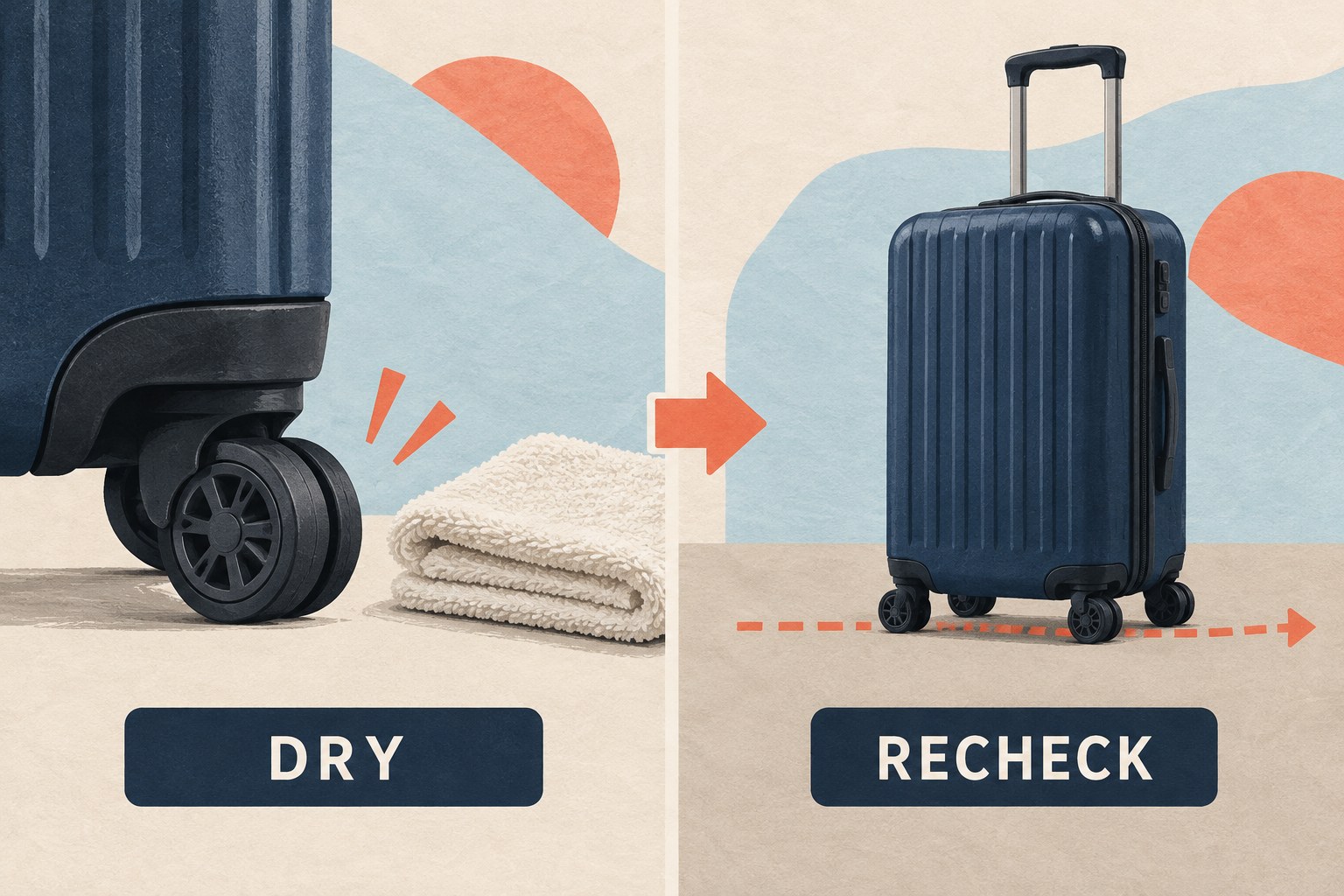
Once dry, repeat the gentle observations and the same short path. Compare the corner notes, not your memory of an airport floor. If the floor, load or route changed, say so; an easier roll under different conditions is not a clean before-and-after comparison.
- No remaining concern: Record what you observed and finish the normal storage routine. This does not guarantee performance under every travel load.
- Unchanged or uncertain: Keep the affected corner identified and consult the model’s support instructions. More cleaning liquid is not an explanation.
- Visible damage, looseness or persistent resistance: Stop forcing the assembly. Prepare a service question rather than assuming cleaning repaired it.
A useful support note is specific: “With the front shown in this photo, corner ___ still catches when ___ after accessible debris was removed using ___. The case was empty on ___ flooring.” Attach only the relevant photos through the brand’s official support route when requested. Do not publish your luggage tag’s personal details in a public troubleshooting post.
Keep a front view, the affected corner close-up and the product identification handy. Samsonite’s official FAQ specifically requests product-label information and front, back and damaged-area pictures for parts inquiries. Other brands may ask for different evidence; your four-corner note is a starting point, not a substitute for their process.
For the rest of the bag, continue with our after-trip suitcase reset checklist. The finish line is pleasantly unglamorous: a dry case, a clear observation, and any unresolved wheel problem written down before departure day.