On an overnight train, a packed item can still be in the wrong place. A toothbrush buried under tomorrow's clothes is technically with you, but finding it may mean reopening a suitcase while the rest of the coach is settling down.
Build your Amtrak overnight coach packing list around four moments: boarding, settling for the night, waking up and stepping off. The worksheet below assigns each item an exact pocket and catches the things you are still using on departure morning. It is an original organization method based on Amtrak's published guidance, not a report of a journey or a promise of comfortable sleep.
This guide covers an ordinary overnight journey in a coach seat. It does not assume a private room, Auto Train vehicle access or the same rules for a connecting bus. Here, seat bag means your permitted personal item, and stowed bag means a carry-on stored aboard the train. Stowed carry-on luggage is different from checked baggage handed to the carrier.
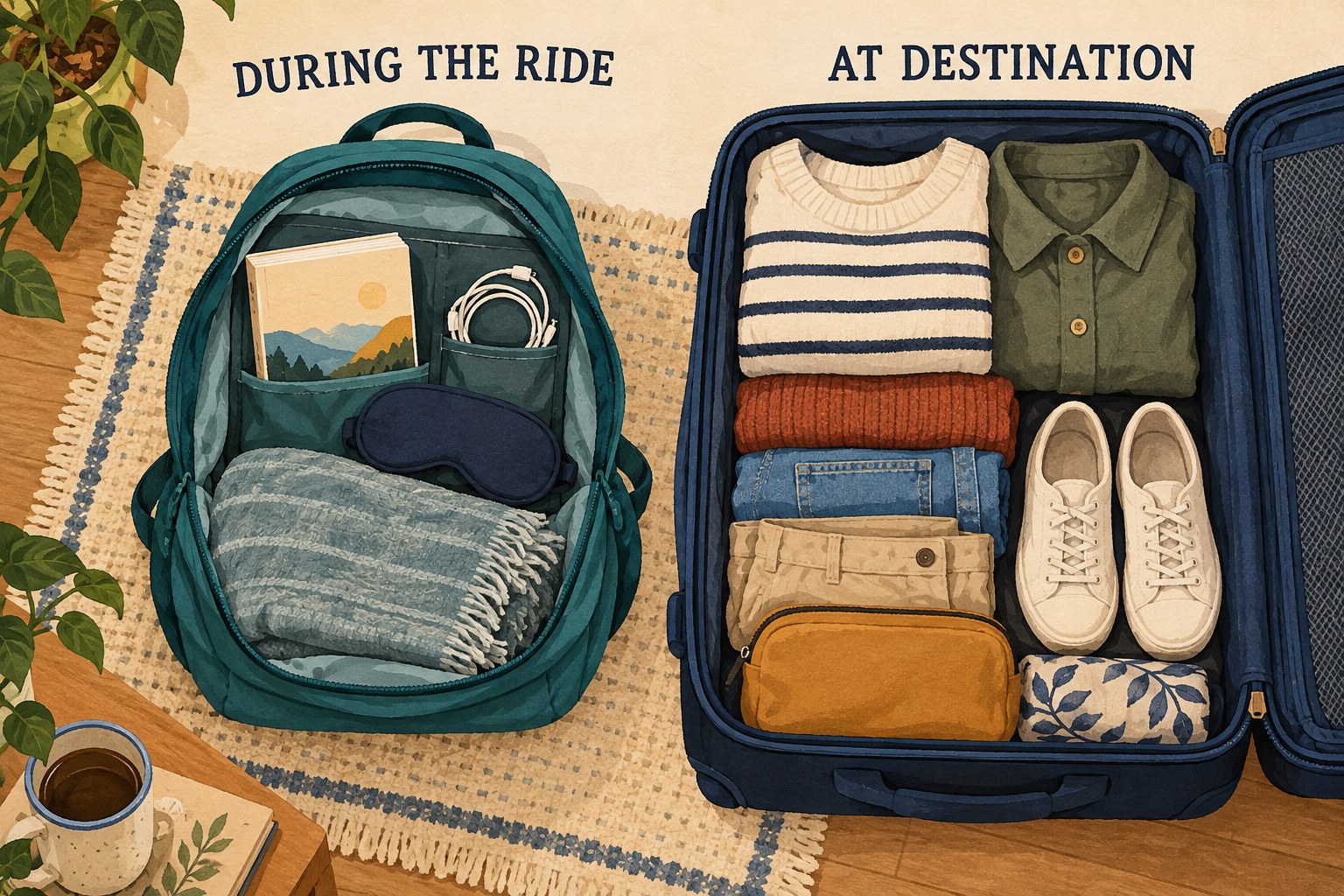
Record the trip before choosing the bags
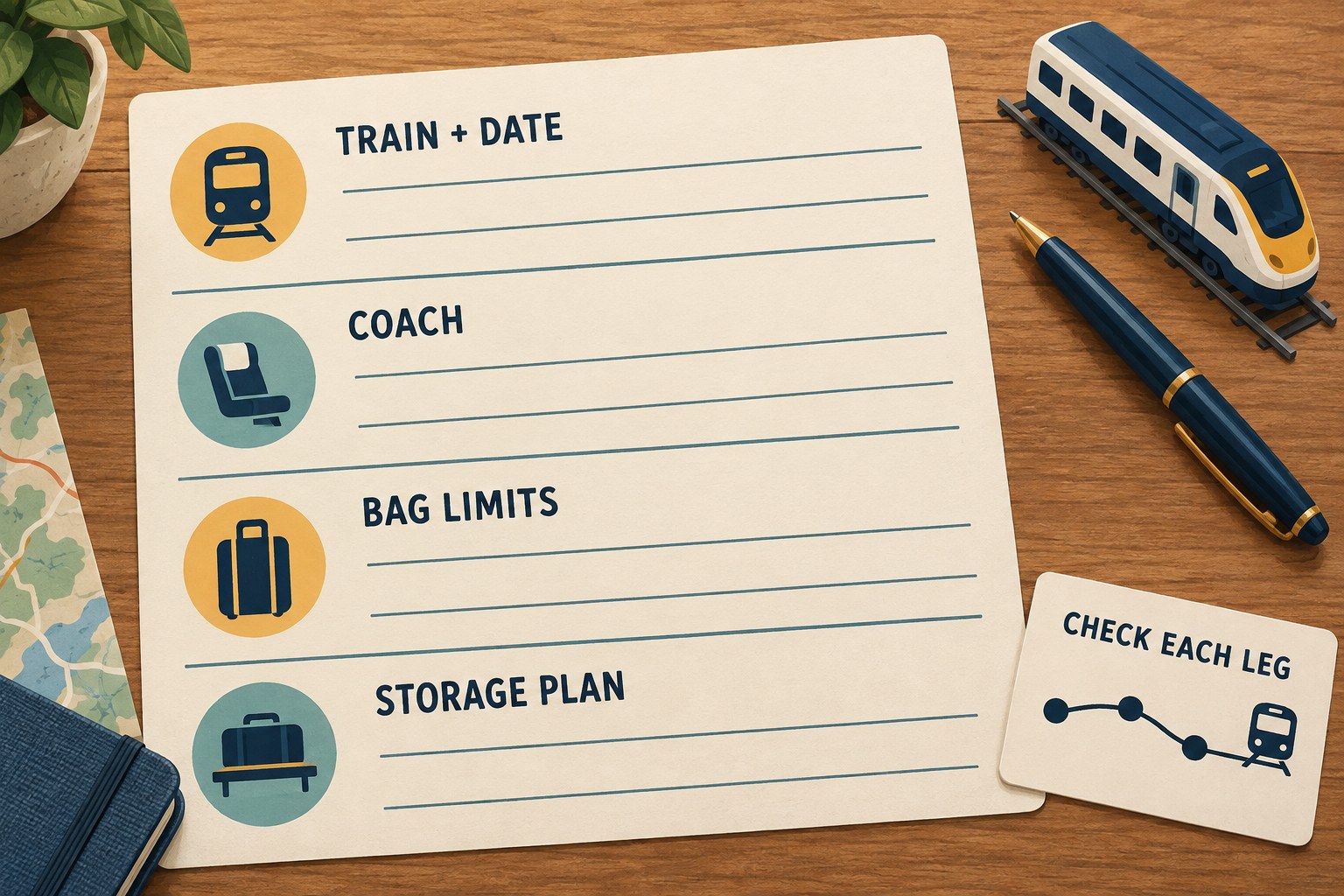
Write down your train, date, boarding and arrival stations, travel class and any connecting service. Use the current policy for each leg. A list written for a roomette or an airline will not settle how to pack for your coach journey.
As checked on October 7, 2026, Amtrak's carry-on policy allows one personal item up to 25 pounds and 14 × 11 × 7 inches, plus two carry-ons up to 50 pounds and 28 × 22 × 14 inches each. Pacific Surfliner has a smaller carry-on depth limit of 11 inches. The personal item must fit under the seat; carry-ons belong in overhead racks or the luggage tower. Do not use empty seats, aisles or vestibules as storage. Amtrak also requires safe overhead lifting capability, station-sizer fit and an outside name-and-address tag on each bag.
Those are maximum allowances, not a packing target. This plan uses one small bag and one larger carry-on if they suit your needs. The small bag is not an extra item beyond the personal-item allowance. Recheck the linked policy before travel, especially if you find an older packing article quoting a different personal-item count.
Pack for four moments, in order
Start with an empty table rather than copying every suggested gadget. For each moment, name the few things you expect to use before the destination. Give them a location you can describe precisely, such as “backpack inner zip pocket,” rather than “somewhere in hand luggage.” Use existing pockets and pouches; matching organizers are optional.
| Moment | Possible items | Access question |
|---|---|---|
| Boarding | Ticket, phone, wallet and the travel documents your trip requires | Can I retrieve the ticket while keeping the rest of the bag closed? |
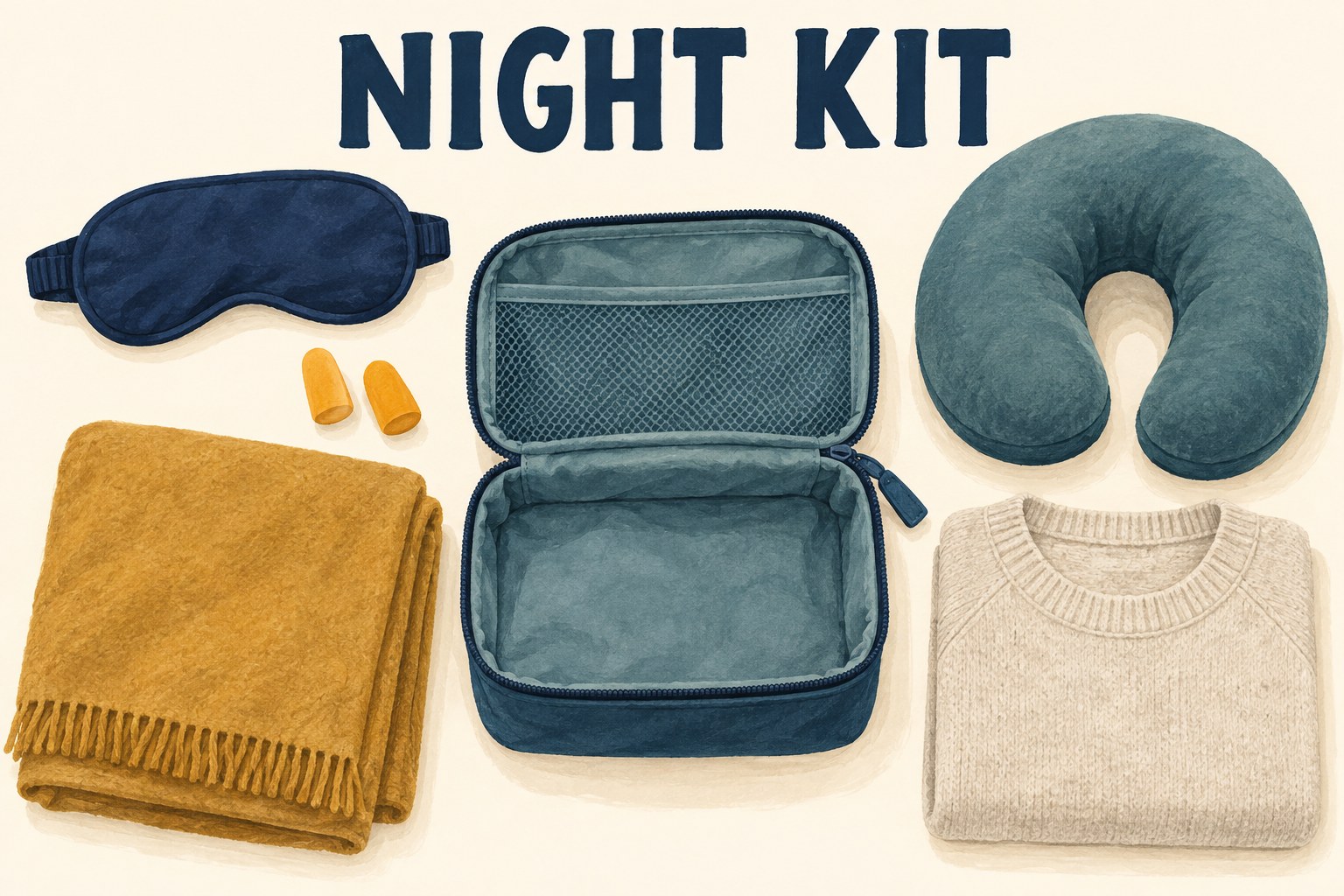
| Settling for the night | Eye mask, earplugs, pillow, light blanket or layer, headphones and chosen entertainment | Can I get ready without opening the larger bag? |
| Waking up | Toothbrush, small toiletry pouch and an optional fresh shirt | Can I take just the morning pouch instead of carrying a whole suitcase? |
| Stepping off | Destination address, keys, weather-appropriate outer layer and anything temporarily taken out | Can I finish repacking before my stop? |
This is a menu, not a requirement to carry every item. Add your own essential personal supplies first. Then move destination-only clothes, spare shoes and other later-use items to the larger bag. If you expect to need a shirt on the train, it belongs in the waking-up row even if the rest of your clothing does not.
Make the night group compact
Amtrak's overnight-coach tips recommend a neck pillow, comfortable clothing, an eye mask, earplugs and a blanket. Choose the items you actually use. Put small pieces together and give the bulkier pillow or blanket a deliberate place; an illustration of a pouch does not mean everything will fit inside it.
Before closing the bag, consider the morning as well as bedtime. A sleep kit packed on top of the only toothbrush pocket may make the second half of the journey awkward. Try separating small night and morning items, or put both in independently reachable pockets.
Give food and entertainment their own checks
Amtrak permits your own food and drinks at your coach seat, but staff cannot heat or refrigerate them for you. Choose ordinary snacks that do not depend on those services and pack a drink you can close securely. Do not assume the same eating permission applies in every dining or lounge area. Personal alcohol cannot be consumed in coach.
Record where the food will sit after the bag is closed. If retrieving a snack requires removing your ticket wallet and balancing it on your lap, change the layout at home. Keep food separately contained from documents, cables and toiletries.
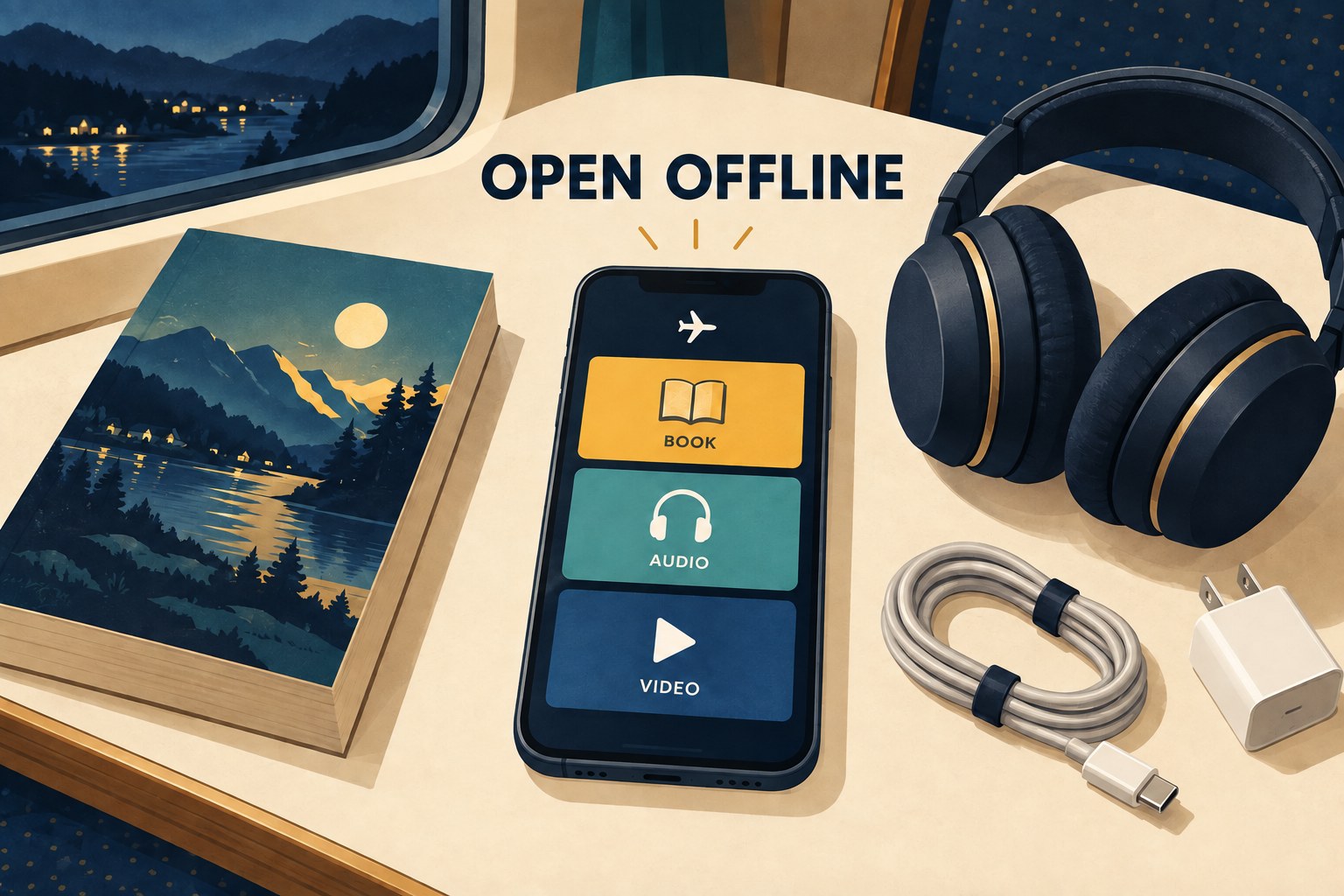
Amtrak's coach description lists electric outlets and requires headphones for sound-emitting devices. Bring a compatible wall charger and cable rather than assuming there will be a particular USB socket. This guide does not establish the condition or exact location of an outlet on your train.
Amtrak Wi-Fi is available on selected trains and stations; its basic service is not intended for streaming or large downloads and depends on cellular coverage. Download your chosen entertainment before leaving. Then temporarily disconnect from Wi-Fi and mobile data and open the actual book, audio or video you intend to use. A title in a library is not proof its content has downloaded. Restore your normal connection settings afterward.
Copy the overnight access worksheet
Use one row per item or small group. “Still in use” is a useful status: the charger beside your bed and the toothbrush beside your sink are not packed just because they are on the list. Name the last move that will put each into the correct pocket.
My overnight coach access plan
Train and date: __________
Boarding station / arrival station: __________
Coach confirmed; connecting legs checked: __________
Current baggage-policy link and date checked: __________
Seat bag / larger carry-on: __________
| Moment and item | Exact bag or pocket | Ready or still in use? | Last move / offline check |
|---|---|---|---|
| Boarding: __________ | __________ | __________ | __________ |
| Night: __________ | __________ | __________ | __________ |
| Morning: __________ | __________ | __________ | __________ |
| Arrival: __________ | __________ | __________ | __________ |
| Destination-only: __________ | __________ | __________ | __________ |
For the ticket row, Amtrak supports displaying an eTicket barcode on a mobile device or using a printed eTicket; the ticket is also provided as a PDF with the emailed receipt. Save the actual PDF and check that it opens before leaving, or print it. Keep any other required travel documents ready too; this worksheet is not a ticketing or identification exemption.
A worked example: the charger that is not packed yet
Imagine Sam traveling overnight in coach. This is a fictional example. Sam's phone is charging at home, while tomorrow's shirt is already folded in the suitcase.
- Boarding: ticket PDF saved and opened; phone will go in the backpack's inner zip pocket before leaving.
- Night: eye mask and earplugs are in the small top pouch. Charger is marked “still in use”; its last move is from the wall to the side pocket.
- Morning: Sam wants the fresh shirt before arrival, so it moves from the suitcase to the morning group now.
- Arrival: keys and destination details have known locations. The charger must come back from the seat area before stepping off.
The useful change is not an extra purchase. It is catching two location errors before boarding: a charger still at home and a morning item buried in destination luggage.
Rehearse the sequence with the larger bag closed
At home, sit beside your packed personal item and leave the larger bag closed. This is a proposed organization check, not a simulation of a particular train's under-seat dimensions.
- Retrieve the ticket and return it to its closed pocket.
- Take out the night items you chose, then put them away.
- Retrieve the morning pouch without removing unrelated clothes.
- Find your arrival details and keys, then close the bag with all items back inside.
If you repeatedly empty the backpack to find one thing, move that item or remove optional bulk. Separately check packed dimensions, weight and your ability to handle the bags. A successful home rehearsal does not confirm that a bag fits the train.
After boarding, follow the crew's storage instructions and keep the aisle clear. Put items back into their assigned pockets after use. Before your stop, work backward through the four moments: gather what came out, close the bags and make sure the items needed immediately after arrival are reachable. The goal is a bag arrangement that still works the next morning.