A useful gift thank-you note starts with three things you already know: who gave the gift, what arrived and one detail you can honestly add. Put those facts into a short message, then record when you actually send it. A beautiful card sitting on the desk is still unfinished.
This guide gives you a gift-detail worksheet, adaptable examples and a small received-to-sent tracker. Use it for ordinary personal gifts. It is a writing aid, not a rule that every occasion or relationship needs the same kind of note.
1. Record the gift before polishing the words
Make a small record while the gift and its tag are together. Check the giver's name, including everyone named on a joint gift, and describe the item specifically enough that you will recognize it later. “Blue mug” is more useful than “present.” If several parcels arrive together, match each card to its item before putting the packaging away.
Hallmark's thank-you-note guide recommends listing the people to thank and checking how their names are spelled. That small check is worth doing before drafting. If you cannot identify a giver, write “check sender” in your private record rather than guessing whom to thank.
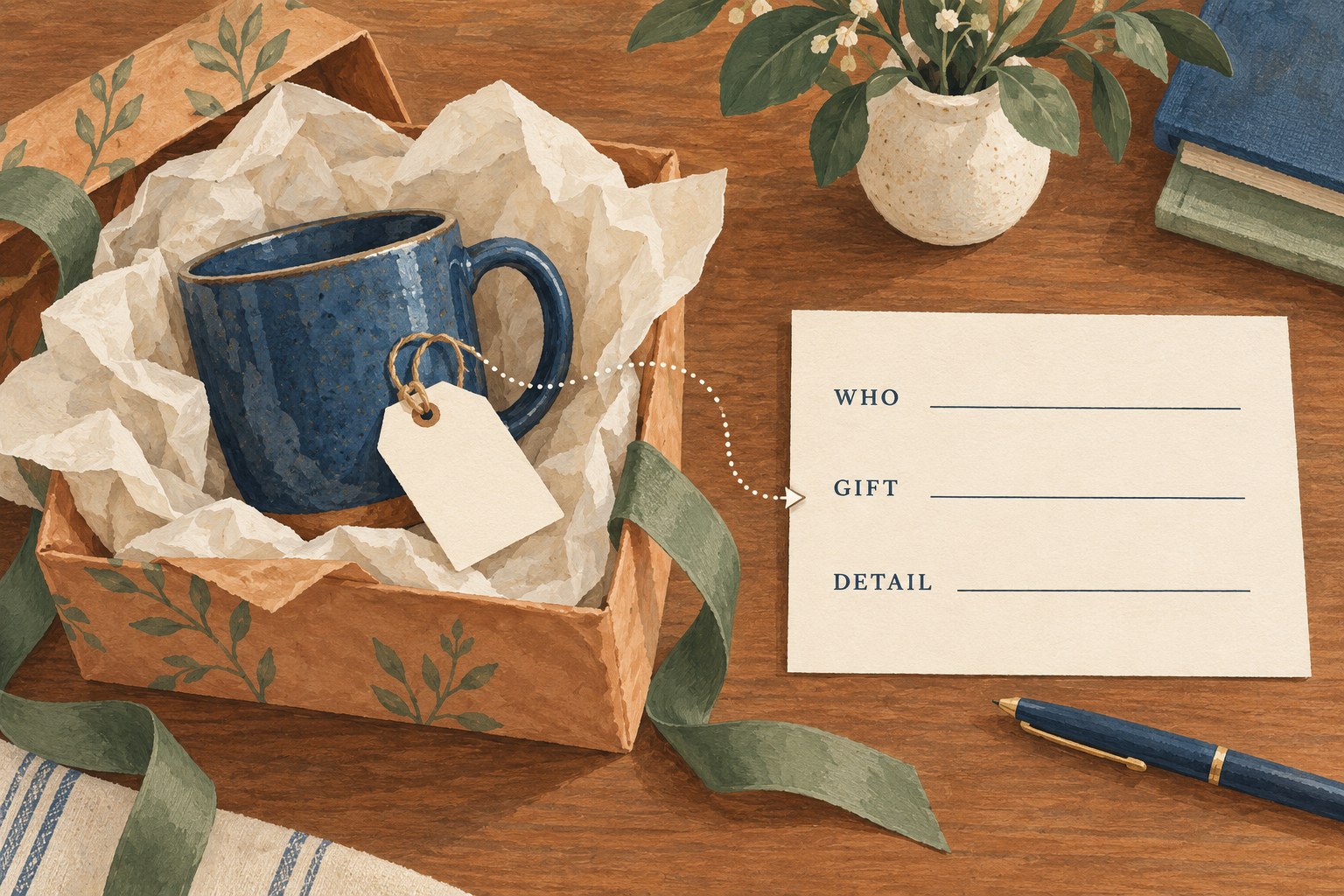
Copy this preparation card into a notebook or a private document:
- Person or people to thank: ______
- Gift received: ______
- Occasion, if relevant: ______
- One detail I know is true: ______
- Detail type: already happened / genuine plan / appreciation for the gesture
- Greeting and closing that suit this person: ______
- Anything I need to check: ______
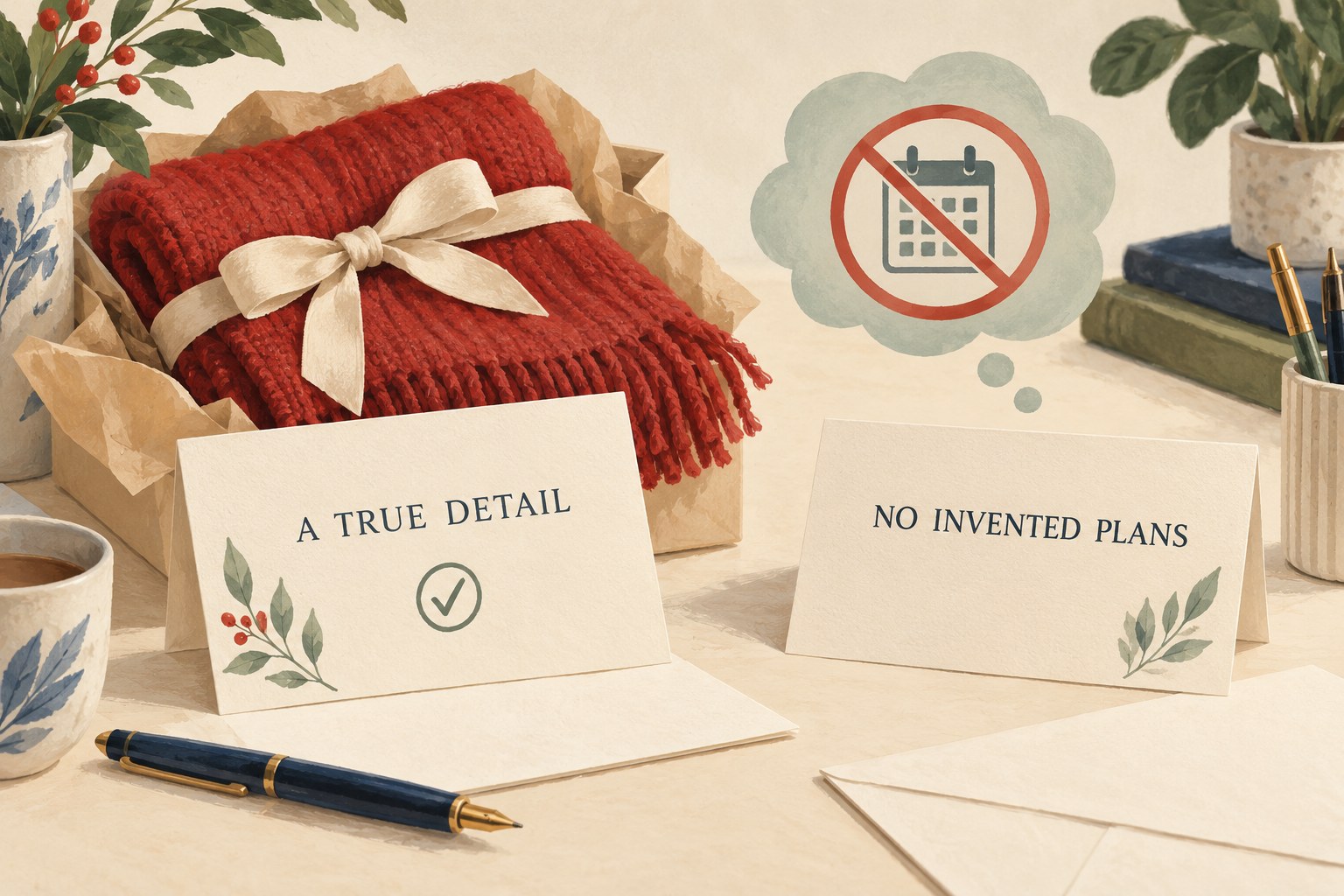
The detail does not have to be impressive. You might have used the mug at breakfast, noticed its comfortable handle or simply appreciated that someone remembered you. Do not invent a use story to make a note sound personal. Likewise, do not assume a gift was handmade or describe hours of effort unless you know that is true.
2. Build a short note around one truthful detail
Start with the person's name. Thank them for the specific gift, add your detail and close in language you would normally use with them. An extra personal line is optional. A familiar greeting can suit a friend; a more formal greeting may suit someone you know less well.
The British Council's English thank-you-card guide, published September 25, 2026, emphasizes matching tone to the relationship and making the message specific. You do not need elaborate vocabulary to do either.
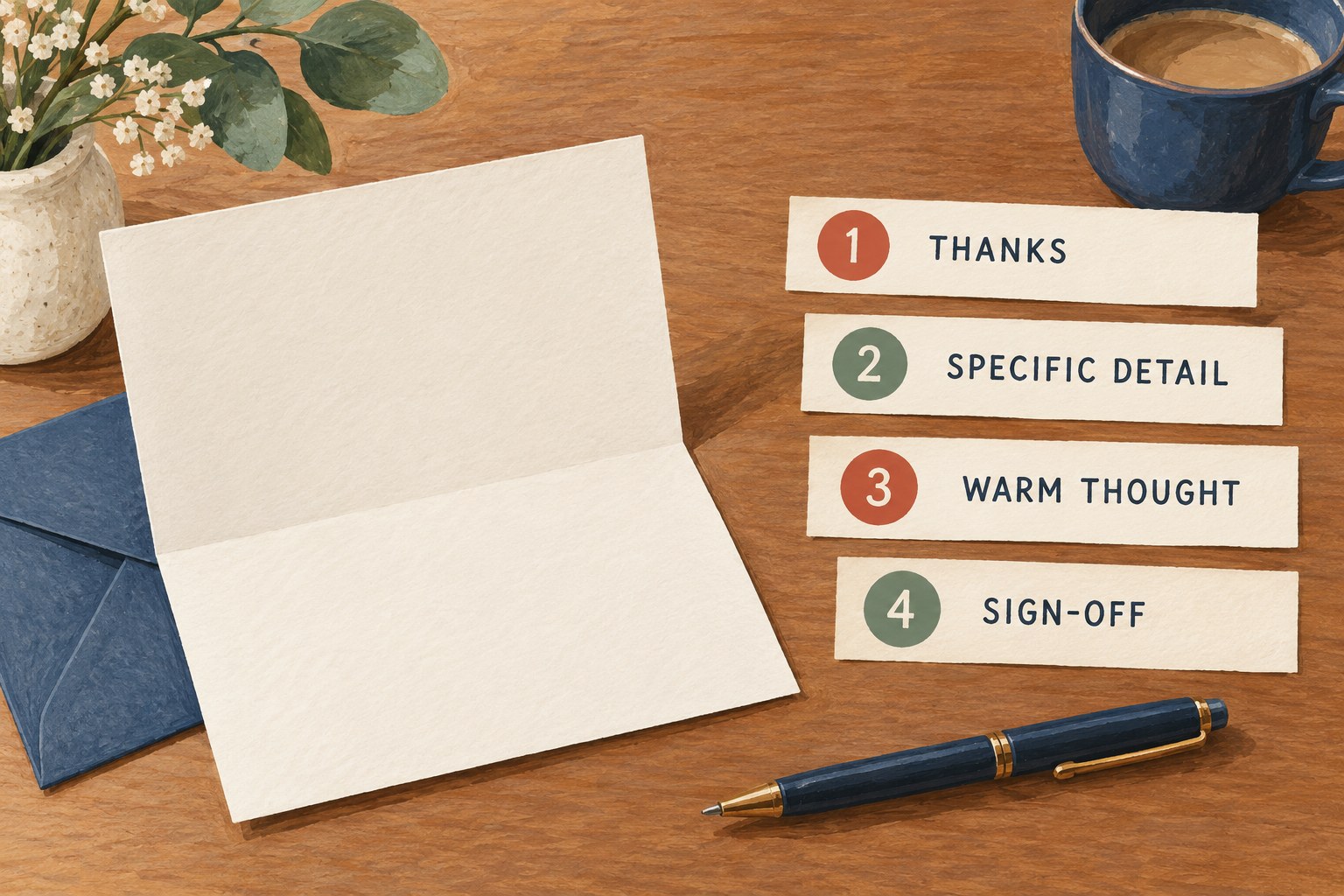
Use this flexible scaffold, then remove the brackets:
Hi [name],
Thank you for [specific gift]. [One accurate sentence about the gift or your appreciation.] [Optional personal line that is true.]
[Closing],
[Your name]
Read your detail once more and choose the right tense. “I used it” describes something that happened. “I plan to use it” describes a real intention. If neither fits, thank the giver for the gesture without adding a use claim. An optional line should not accidentally promise a visit, a photograph or a phone call you did not intend to offer.
3. Adapt examples without borrowing someone else's facts
The following notes are fictional examples. Keep only the details and feelings that fit your situation. Their purpose is to show choices, not to give you a script that must be copied word for word.
A gift you have already used
Hi Lena,
Thank you for the blue mug. I used it for my breakfast tea this morning, and the wide handle is comfortable to hold. Thanks for thinking of me.
Love,
Sam
This version names one ordinary use and one observable feature. If you have not used the gift yet, change the sentence rather than presenting a plan as a memory.
A gift you genuinely plan to use
Dear Alex,
Thank you for the sketchbook. I'm looking forward to taking it on my next park walk so I can try drawing the trees. I appreciate you remembering my interest in sketching.
Best,
Morgan
The planned activity belongs in the note only if it is actually your intention. You can also stop after a simple, sincere thank-you.
A gift of money
Dear Jo,
Thank you for the birthday money. I'm putting it toward the drawing class I've wanted to take. I appreciate your help with something I'm excited to try.
Love,
Casey
If you have no plan yet, omit the spending sentence. Emily Post's guidance on different ways to say thank-you treats mentioning the amount as optional. You do not need to force a number or an invented purchase into your message.
A gift that is not quite your taste
Hi Dana,
Thank you for the scarf and for remembering my birthday. I appreciate you thinking of me.
Warmly,
Ellis
You can acknowledge the gift and kindness without claiming you love the style or will wear it constantly. Keep the occasion accurate too: the example's birthday line belongs only in a birthday note.
A note that is already late
Dear Robin,
I'm sorry this note is late. Thank you for the serving bowl. We used it for Sunday's salad, and there was room for everything without crowding the table. Thanks again for thinking of us.
Love,
Taylor
Hallmark suggests briefly acknowledging lateness, then continuing with the thanks. Avoid turning the whole note into a long account of why it was delayed. If your real gift has not been used, choose a different truthful detail.
4. Track received, drafted and sent as different states
Use one place to see what remains. A paper list or ordinary private note is enough; you do not need a new app. The following status definitions are our organizing convention, not an etiquette standard:
- Received: the gift is recorded, but the note is not ready.
- Draft: the wording is ready, but the card or message has not been sent.
- Sent: you sent the message, mailed the card or handed it over.
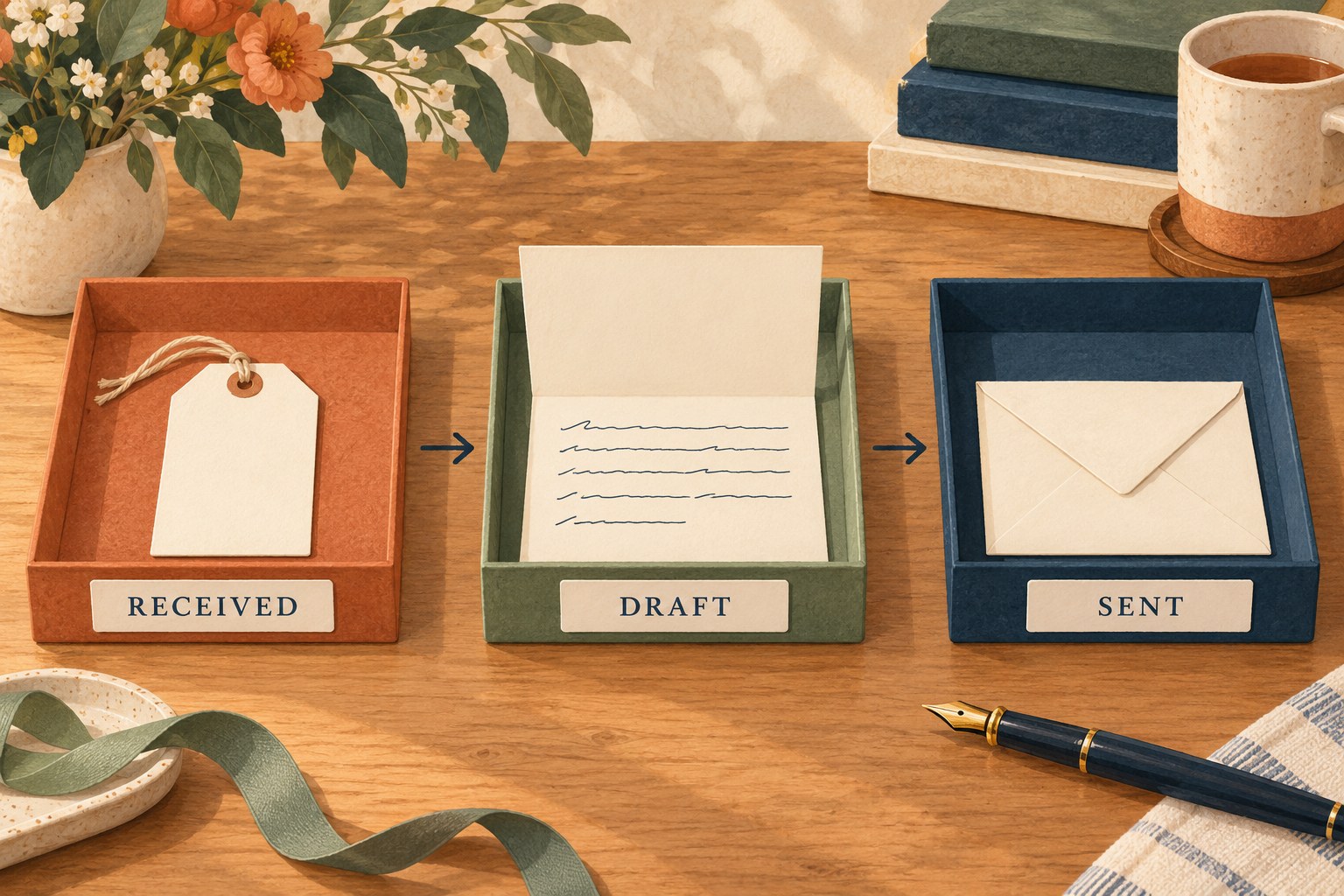
Here is a fictional working list. “Sent” records your action; it does not prove the recipient received or read the note.
| Giver and gift | Received | True detail | Status | Sent date | Next step |
|---|---|---|---|---|---|
| Lena: blue mug | Oct 2 | Breakfast tea; wide handle | Draft | — | Check address, then mail |
| Jo: birthday money | Oct 3 | Drawing-class plan | Sent | Oct 4 | None |
| Robin: serving bowl | Oct 1 | Sunday salad | Received | — | Write the note |
If you quickly acknowledged a delivered gift by text or phone, add a separate “arrival acknowledged” date and channel. That record helps you distinguish “I told them it arrived” from “I finished the note I intended to send.” Do not automatically mark the formal note sent because you made an earlier call.
Keep addresses in your existing contacts rather than duplicating them in a gift spreadsheet. Gift prices are not needed for this workflow. If someone is helping, share only the details needed to check the gift and prepare the note. For a joint gift, make sure your wording includes all the givers; decide which person or household should receive the note instead of assuming the parcel sender is the only giver.
5. Choose the channel, then do the actual send step
The right form depends on the occasion and relationship. Emily Post distinguishes some everyday gifts opened with the giver present, where sincere spoken thanks can be enough, from occasions such as weddings and showers with stronger written-note conventions. Treat that as contextual etiquette guidance, not a universal demand for a handwritten card after every gift.
A quick arrival acknowledgment can be useful when a giver is waiting to hear whether a package reached you. Decide separately whether the occasion calls for a written note. For everyday personal gifts, consider how you normally communicate and what would be comfortable for the recipient. This guide does not set a single deadline for every occasion.
Try to send your thanks while the details are fresh. If the note is already late, a short honest message is a practical next step. Finish one note before spending more time redesigning the tracker.
- Correct person or people and correctly spelled names?
- Correct gift, with no uncertain attribution?
- Every use, plan and personal detail true?
- No leftover brackets or unintended promises?
- Address or digital recipient checked?
- Message sent, or card actually mailed or handed over?
- Sent date added only after that action?
If a digital message fails to send or a card comes back, change the next step to resolving the delivery problem. Keep the original attempt date if it helps, but do not let a completed checkbox hide unfinished work.
Sources and scope
The linked Hallmark, Emily Post and British Council pages were checked October 6, 2026. They provide writing and etiquette guidance; expectations vary between people, families and occasions. The worksheet, tracker definitions and fictional examples here are original planning aids. The five illustrations are AI-generated concepts, not photographs of real gifts or correspondence.